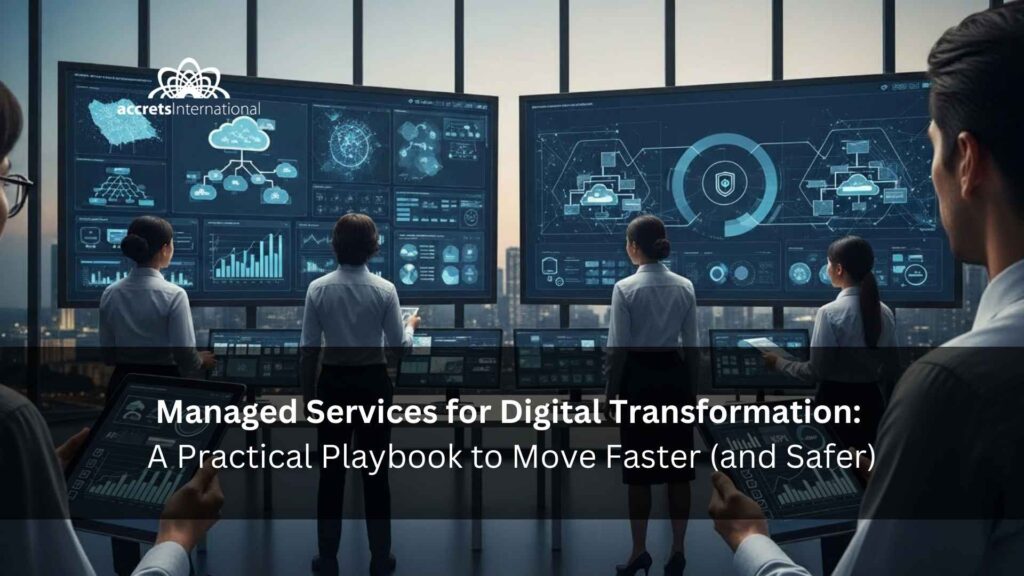

Managed services for digital transformation means using an expert operating partner to run, improve, and continuously optimize key IT functions while your internal team focuses on modernization initiatives like cloud migration, cybersecurity uplift, resilience, and application improvement.
In practical terms, the right managed services model reduces operational noise, increases reliability, strengthens governance, and accelerates time-to-value with measurable KPIs and SLAs. In this guide, we will walk through what managed services includes, how to scope it using a Run, Enhance, Transform framework, how to choose the right model, and how to measure success so you can confidently move faster and safer all the way to the finish.
TL;DR: Managed services accelerates digital transformation by stabilizing day-to-day operations, creating capacity for change, and delivering measurable outcomes through clear scope, governance, KPIs, and a structured transition plan.
Why this guide exists
Digital transformation rarely fails because a company picked the wrong cloud or chose the wrong tool. It fails because the organization cannot keep the lights on and modernize at the same time. Day-to-day operations consume attention, incidents interrupt plans, and the backlog grows faster than the team can ship. If you want a fast diagnostic on the common pitfalls, start with Accrets’ breakdown of why companies fail at digital transformation and how not to.
This guide is designed for global teams, including organizations using Singapore as a regional hub, who want a practical method to scope managed services correctly, choose the right engagement model, and measure success with clear KPIs before speaking to vendors.
What managed services means in digital transformation and what it does not
In digital transformation, managed services means an external provider takes ongoing responsibility for defined IT functions. That responsibility includes operating the service, improving it over time, and reporting performance consistently.
Managed services is not the same as:
- Break-fix support, where help arrives only after something breaks
- Staff augmentation, where you rent extra hands but keep full operational accountability
- One-time implementation projects, where a vendor delivers and exits
- Cost-only outsourcing, where transformation outcomes are not clearly defined
If your team is still untangling these terms, Accrets’ explainer on managed vs cloud services: the difference and which do you need provides a clean boundary. If you want a current market lens, why partnering with a managed cloud services provider matters in 2025 is useful for setting expectations. If your transformation includes AI, data platforms, or governance requirements, align early with managed vs cloud services: navigating AI model governance in 2025.
Common triggers behind the keyword “managed services digital transformation” include:
- Transformation backlog is real but execution keeps slipping
- Cloud, hybrid, or multi-cloud complexity is increasing operational load
- Security expectations rise due to compliance or incident pressure
- 24/7 operations are needed without expanding headcount
Why managed services accelerates digital transformation
Most leadership teams underestimate the biggest constraint: change capacity.
Transformation competes with run work. When the same people must do both, the urgent wins over the important, and modernization slows down. Managed services accelerates transformation by creating space, consistency, and measurable improvement.
Key accelerators:
- Reduced operational noise through monitoring, incident response, patching, and routine execution
- Standardized operations via repeatable runbooks, controls, and reporting cadence
- Improved security and resilience while change is happening, not after the fact
If you need a clear view of what operational scope should be stabilized first, Accrets’ primer on what IT infrastructure management services are is helpful. If you want to avoid scaling problems during modernization, align stakeholders around IT infrastructure capacity planning early.
Scope it correctly with the Run, Enhance, Transform model
The fastest way to prevent a managed services engagement from underdelivering is to make scope explicit using three buckets.
Run: Keep the environment stable
Run includes the work that protects uptime and baseline reliability:
- Monitoring and alerting
- Incident response and escalation
- Patching cycles and routine maintenance
- Backup checks and restore validation
- Core operational execution
Enhance: Optimize continuously
Enhance includes ongoing improvements that reduce cost, risk, and toil:
- Performance tuning
- Cost optimization, including tagging and governance
- Automation for recurring tasks
- Security hardening and vulnerability remediation routines
- Documentation improvements and runbook refinement
Transform: Modernize safely while maintaining service levels
Transform includes modernization work that changes architecture and capabilities:
- Cloud migrations and hybrid enablement
- Platform modernization and resilience uplift
- Network redesign and connectivity improvements
- Identity and security architecture changes
- Virtualization transitions and lock-in mitigation
- Data platform operationalization and governance
If stakeholders need a foundation on cloud and platform concepts, use fundamentals of cloud computing, then connect to practical usage with cloud computing business applications and a simple clarification point via cloud computing and cloud storage difference.
If your transformation includes infrastructure modernization, align on IaaS with advantages of infrastructure as a service, then set boundaries using difference between platform and infrastructure as a service. For build and operations decisions, infrastructure as code vs infrastructure as a service provides a useful tradeoff lens. If you are comparing providers, infrastructure as a service vendors can help speed up shortlisting.
Choosing the right engagement model and when not to use managed services
Managed services is powerful, but it is not universal. Use this checklist to decide.
Managed services is a strong fit when:
- You need reliable 24/7 operations and faster incident response
- You have regulated workloads or strong governance requirements
- You operate hybrid or multi-cloud environments with growing complexity
- You have a transformation backlog and need execution capacity
Managed services is a poor fit when:
- Ownership is unclear, especially who decides priorities and who executes
- You only need a one-time build with no ongoing accountability
- You have no governance capacity to manage outcomes and tradeoffs
- You want transformation without making decisions
Many teams adopt a co-managed model where internal teams keep architecture and product decisions, while the provider runs defined towers and supports transformation sprints. If your organization is still aligning on what outsourcing should mean, use what is IT outsourcing services. If you want a Singapore lens that is still globally useful, corporate IT infrastructure in Singapore: the blueprint for mid-size enterprises helps benchmark baseline operating models.
How to evaluate a managed services provider with RFP questions you can copy
Most providers can claim they do monitoring and security. Your job is to validate how they operate, how they measure outcomes, and how they handle transition and exit.
Evaluate across five dimensions:
- Operating model and governance cadence
- Tooling transparency and your retained access
- Security and compliance posture
- People coverage and skills depth
- Transition plan and exit plan maturity
Copy and paste RFP questions:
- “Show a sample monthly service review report with KPIs and improvement actions.”
- “How do you measure outcomes beyond tickets closed?”
- “What tools do you use for monitoring, ticketing, and observability, and do we retain access?”
- “What is your 30/60/90 transition plan and your stabilization approach?”
- “What is your exit plan, including documentation, credential handling, and data ownership?”
- “Describe a transformation you supported while maintaining uptime. What went wrong and what changed afterward?”
If your audience wants provider context in Singapore, Accrets’ references on IT companies in Singapore, managed service providers (MSP) in Singapore, and digital transformation service providers in Singapore help categorize options and avoid comparing mismatched provider types.
KPIs, SLAs, and outcome-based managed services
A transformation-aligned managed services engagement measures three layers.
Activity metrics
Useful but limited:
- Tickets resolved
- Requests completed
- Changes applied
Service metrics
These protect baseline reliability:
- Availability and uptime
- Response and resolution times by severity
- Mean time to detect and mean time to recover
- Change failure rate
- Patch compliance and vulnerability aging
- Backup success rate and restore verification rate
Outcome metrics
These connect operations to transformation:
- Deployment frequency and release cycle time
- Reduction in high-severity incidents
- Cloud spend variance and unit cost trends
- Compliance adherence and audit readiness
- DR readiness measured by tested RTO and RPO performance
Sample SLA structure:
- Severity 1 response within 15 minutes, resolution target within 4 hours
- Severity 2 response within 1 hour, resolution target within 12 hours
- Severity 3 response within 4 hours, resolution target within 3 business days
If resilience is part of your scope, anchor the program using business continuity planning and disaster recovery (BCP/DR) and make restore capability practical with backup and disaster recovery: what it is, how it works, and how to build a plan that actually restores.
A 30, 60, 90-day transition plan that protects transformation momentum
Transitions are where managed services trust is won or lost. Require a structured plan.
Days 0 to 30: Stabilize and baseline
- Access setup using least privilege principles
- Asset inventory and configuration baseline
- Monitoring onboarding and alert tuning
- Critical incident runbooks refreshed or created
- Backup checks plus initial restore validation
Days 31 to 60: Standardize and harden
- Patching cadence and vulnerability SLAs
- Logging, monitoring, and security baselines
- Documentation expansion and process standardization
- Cloud tagging and cost visibility governance
- Reporting cadence and service review rhythm established
Days 61 to 90: Optimize and begin transformation sprints
- Automation initiatives for recurring tasks
- Reliability practices such as postmortems and error budget thinking
- Transformation backlog triage and prioritization
- First measurable transformation sprint delivered with KPI impact
If you are building or rebuilding a cloud foundation while controlling budget and risk, Accrets’ guide on how to build a cloud computing infrastructure without wrecking your budget or security fits naturally as a transition and modernization planning reference.
If your global team is using Singapore as a hub or deploying into Southeast Asia, the operational context in Singapore cloud VPS: a US buyer’s field guide to speed, cost, and compliance and business IT support in Singapore: a US decision-maker’s field guide can be useful for setting expectations early.
Governance, security, and compliance for global teams with Singapore reality
Managed services performs best with explicit governance:
- Weekly operational review covering incidents, changes, and risk
- Monthly service review covering KPIs, improvements, and value delivered
- Quarterly roadmap review aligning transformation priorities and budget direction
Security and compliance scope should include:
- Privileged access management approach
- Logging coverage and retention
- Vulnerability management cadence
- Change control discipline
- Incident response playbooks and postmortems
If you want public-sector context, Accrets’ overview of Singapore’s government digital transformation is a useful reference. If Government Commercial Cloud applies to your environment, see GCC Government Cloud Singapore. For security-first execution, consider cloud security consulting services in Southeast Asia and the operational blueprint in infrastructure security in cloud computing: a Singapore-first multicloud playbook.
Infrastructure choices that make or break transformation
Infrastructure decisions have long tails around performance, compliance, resilience, and lock-in.
If hybrid patterns are on your roadmap, Accrets’ reference on hybrid cloud providers in Singapore: the guide for US-based teams supports provider evaluation, and for execution and operations scope you can reference infrastructure IT outsource service in Singapore.
For data center strategy, Accrets’ guidance on Tier 2 data centers in Southeast Asia and when US companies should choose Singapore helps frame regional decisions. When stakeholders ask what tier classifications mean, these references can support alignment: Tier 1 data center definition, Tier 3 data center definition, Tier 4 data center, and Tier 5 data center.
If virtualization strategy is a transformation driver, use VMware alternatives and the leadership lens in VMware digital transformation: a practical playbook for global IT business leaders.
If private cloud and OpenStack are part of your platform direction, references like OpenStack private cloud, OpenStack architecture in cloud computing, and OpenStack architecture: a practical guide for global teams can help with internal alignment. Migration details can be supported by VMware storage migration and the practical breakdown in hot vs cold migration in VMware.
Mini caselets showing managed services in practice
Caselet A: Cloud migration plus platform operations
Context: A global team migrates customer-facing workloads while maintaining uptime.
Scope: Run for monitoring and incident response, Enhance for cost and reliability improvements, Transform for migration waves.
KPIs: Change failure rate, mean time to recover, deployment frequency, cloud spend variance.
Outcome: Fewer high-severity incidents during migration and faster release cycles post-migration.
Caselet B: Security operations uplift during modernization
Context: A company expands remote work and modernizes identity and endpoints.
Scope: Run for patching and monitoring, Enhance for vulnerability SLAs, Transform for security architecture changes.
KPIs: Patch compliance, critical vulnerability aging, mean time to detect, mean time to recover.
Outcome: Reduced exposure window and improved incident response discipline.
If financial services is central to your environment, Accrets’ guidance on cloud banking solutions and what financial institutions in Singapore and Southeast Asia need to know can help frame sector-specific expectations.
Caselet C: DR readiness improvement for business-critical systems
Context: Backups exist but restore confidence is low.
Scope: Run for backup monitoring, Enhance for restore testing, Transform for DR architecture improvement.
KPIs: Restore success rate, tested RTO and RPO, test frequency.
Outcome: Improved resilience confidence and better executive visibility into risk.
For broader context, use ASEAN digital transformation and, for customer-led initiatives, connect operations to outcomes via digital transformation customer experience.
Common failure modes and how to avoid them
Most disappointments follow predictable patterns:
- Undefined ownership on priorities and tradeoffs
- SLAs that measure speed but not outcomes
- No exit plan, leading to documentation debt and switching pain
- Transformation backlog without prioritization, causing reactive work to win
If you want a sharper diagnostic and prevention plan, revisit why companies fail at digital transformation and how not to and apply the Run, Enhance, Transform scope model to restore accountability.
How Accrets helps when you are ready
If you want help scoping Run, Enhance, Transform, defining outcome-based KPIs, and building a transition plan that protects transformation momentum, Accrets can support you through its managed service provider offering.
For infrastructure-heavy scopes, teams often start with managed IT services or a broader managed cloud service provider engagement, and you can see the approach behind it in why Accrets.
If your transformation requires modernization and implementation support, Accrets’ IT infrastructure solutions cover tracks like cloud infrastructure as a service, enterprise cloud computing, cloud service broker, on-premise private cloud, and IT implementation services.
If resilience is your priority, align outcomes to IT DR as a Service and managed backup services.
If your transformation includes workplace productivity or application modernization, Accrets supports enterprise applications including enterprise email and Office 365, online collaboration tools, and SAP Business One.
If connectivity is a major factor for global operations, Accrets’ enterprise connectivity includes Teridion connectivity solution and, where relevant, Teridion cross-border connection for China.
If VMware lock-in is a driver, Accrets also offers a structured path to modernization through Escape VMware lock-in: unleash cloud freedom with Accrets OpenStack migration. If you want stakeholder-ready collateral, Accrets also provides solution brochures.
Free consultation
To map your Run, Enhance, Transform scope, define KPIs and SLAs, and build a 30, 60, 90-day transition plan, fill the form for a free consultation with an Accrets Cloud Expert on Accrets contact us.

Dandy Pradana is an Digital Marketer and tech enthusiast focused on driving digital growth through smart infrastructure and automation. Aligned with Accrets’ mission, he bridges marketing strategy and cloud technology to help businesses scale securely and efficiently.