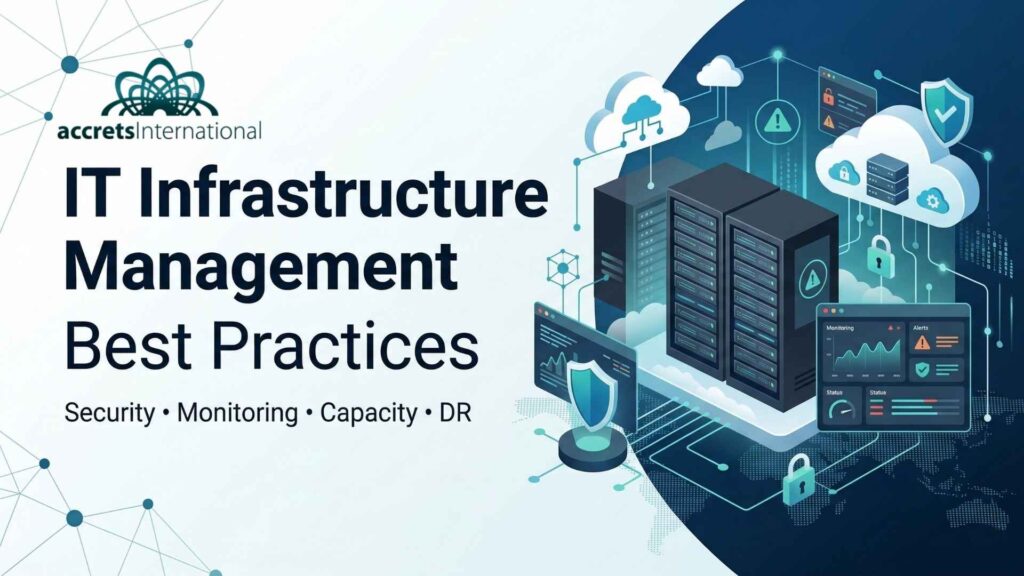

TL;DR: The best practices for IT infrastructure management are to standardize configurations, monitor proactively, plan capacity continuously, operate security daily, test backup and disaster recovery, automate change, choose the right operating model, and review everything on a fixed cadence. Read on and we will walk through each one in a practical way so you can apply them with confidence.
The best practices for IT infrastructure management are the operating disciplines that keep infrastructure reliable, secure, scalable, and recoverable. In practical terms, that means standardizing how systems are built, monitoring what affects service health, planning capacity before growth creates risk, treating security as an everyday control, validating backup and recovery outcomes, and continuously reviewing the environment as it changes. Read through to the end and we will bring these practices together into a clear action plan you can use.
IT infrastructure management is no longer just about keeping servers online and troubleshooting issues as they appear. For modern businesses, infrastructure performance affects uptime, security, scalability, customer experience, and even how quickly teams can launch new products or enter new markets.
That is why strong infrastructure management is less about reacting to incidents and more about building an environment that is stable, observable, secure, and ready to grow. Whether you run on premises systems, cloud workloads, or a hybrid model, the same principle applies: infrastructure should support the business, not slow it down.
At its core, IT infrastructure management covers the oversight of servers, networks, storage, virtual machines, cloud resources, access controls, monitoring systems, and recovery planning. For organizations that want a broader operational view, it helps to understand what IT infrastructure management services include and how those responsibilities are divided across internal teams, providers, and platforms.
Below are the best practices that matter most if you want infrastructure that stays reliable under pressure and scales with confidence.
What IT Infrastructure Management Covers
IT infrastructure management includes the systems and processes required to keep core technology services running well. That usually means managing hardware, virtual infrastructure, storage, networks, cloud resources, observability, identity and access controls, backup, disaster recovery, and lifecycle operations.
The goal is not simply to keep systems available. It is to keep them secure, efficient, resilient, and aligned with business demand. For mixed audiences, it can also help to understand the difference between cloud computing and cloud storage and how infrastructure responsibilities differ from broader service models such as platform as a service versus infrastructure as a service.
The 8 Best Practices for IT Infrastructure Management
These best practices are presented in a practical sequence. They are not random tips. Together, they create the operating foundation that helps modern IT teams reduce fragility, improve visibility, and support growth more confidently.
1. Standardize Configurations and Document the Environment
One of the fastest ways infrastructure becomes fragile is when systems are built differently over time, with inconsistent naming, patch levels, access rules, and undocumented exceptions. Standardization is what turns infrastructure from a collection of individual setups into an environment that can actually be managed.
Start by standardizing:
- Server builds
- Operating system baselines
- Patch schedules
- Network naming conventions
- IAM role structures
- Backup policies
- Workload tagging
Then support those standards with documentation that stays useful in real operations, not just during audits.
Good documentation should include:
- Architecture diagrams
- System owners
- Service dependencies
- Escalation contacts
- Backup scope
- Change history
- Recovery order for critical systems
Teams managing growth across multiple business units often benefit from a more formal blueprint, similar to this guide to corporate IT infrastructure for mid size enterprises.
What good looks like in practice: When a key system fails or a planned change must be rolled back, the team should not depend on tribal knowledge to understand how the environment works.
2. Build Proactive Monitoring Around Service Health, Not Just Device Alerts
Many teams say they have monitoring in place, but what they really have is alert noise. A flood of isolated warnings is not the same as meaningful operational visibility.
Strong infrastructure management starts with monitoring the indicators that actually reflect service health, including:
- CPU and memory saturation
- Storage latency and IOPS
- Packet loss and bandwidth utilization
- Failed logins and unusual access patterns
- Certificate expiration
- Replication health
- Application response times
- Backup job status
From there, alerts need thresholds, escalation logic, and ownership.
The purpose of monitoring is not to prove you have a tool. It is to reduce mean time to detect and mean time to resolve. That means alerts should point the team toward action, not just awareness.
If your organization is reviewing tooling options, this guide to the best tools for IT infrastructure monitoring services can help frame what to look for beyond basic uptime checks.
What good looks like in practice: The best monitoring strategy is the one that tells you early when performance, availability, or security is moving in the wrong direction.
3. Make Capacity Planning a Continuous Discipline
Capacity planning is often treated like a one time project, usually right before a major expansion or after performance has already started to degrade. In reality, it should be an ongoing discipline.
A healthy infrastructure environment needs regular reviews of:
- Compute usage
- Storage growth
- Network throughput
- Dependency growth
- Seasonal or planned demand shifts
Start by baselining current resource usage. Then compare that data against business forecasts, product launches, regional traffic growth, compliance requirements, and recovery expectations. Historical utilization matters, but it is not enough on its own.
This is especially important in hybrid and cloud heavy environments, where overprovisioning can quietly inflate cost while underprovisioning leads to outages or poor performance. A structured approach to IT infrastructure capacity planning helps teams avoid both extremes.
Capacity planning should also account for the underlying environment. For example, high availability requirements may affect data center strategy, and teams comparing resilience levels may need to understand the differences between a Tier 3 data center and a Tier 4 data center.
What good looks like in practice: The real objective is not just adding more resources. It is making sure infrastructure remains right sized, cost aware, and prepared for what the business will ask of it next.
4. Treat Security as an Operating Control, Not a Separate Project
Security is often discussed as a design consideration, but in infrastructure management it has to function as a day to day operating control. An environment is only as secure as its ongoing patch discipline, access governance, logging coverage, and configuration consistency.
That means enforcing:
- Least privilege access
- Regular privileged account reviews
- Network segmentation
- Patch and vulnerability workflows
- Logging and telemetry coverage
- Drift detection between intended and actual configurations
Security also needs to extend across cloud and hybrid environments, where inconsistent controls create hidden risk.
For teams operating across multiple platforms, a practical starting point is this multicloud infrastructure security playbook, which helps connect security controls to real operating decisions rather than abstract policy statements. Organizations that need more specialized support may also look at cloud security consulting services in Southeast Asia when internal teams need help tightening operational controls.
What good looks like in practice: The best security posture is not built by one project. It is maintained by consistent infrastructure operations.
5. Design Backup and Disaster Recovery Around Real Recovery Outcomes
A common mistake in IT infrastructure management is assuming that backup and disaster recovery are the same thing. They are closely related, but they solve different problems.
Backups protect data. Disaster recovery restores operations.
That distinction matters because many companies discover too late that although data was backed up, the business still cannot recover critical services within the time required. That is why every infrastructure team should define recovery time objectives and recovery point objectives by workload tier, map dependencies between systems, and test restore procedures on a scheduled basis.
Recovery planning should include:
- RTO and RPO by workload tier
- Dependency mapping
- Restore testing cadence
- Identity system recovery
- Database and storage order
- Networking dependencies
- Application restart requirements
- Assigned recovery owners
This is where a strong guide on backup and disaster recovery that actually restores becomes much more valuable than a generic recommendation to simply have backups.
If your team is formalizing resilience planning, resources such as a business continuity and disaster recovery guide or an IT disaster recovery plan template can help translate policy into action.
What good looks like in practice: Recovery expectations should be realistic, tested, and aligned with business priorities.
6. Align Change Management, Automation, and Infrastructure as Code
Infrastructure becomes unstable when changes are made manually, inconsistently, or without rollback planning. Even skilled teams introduce risk when updates happen outside a repeatable process.
That is why mature infrastructure management connects change management with automation. Reusable templates, approval workflows, version controlled configuration, and rollback procedures reduce the chance of drift and make incidents easier to trace. Infrastructure as code is especially valuable here because it turns configuration into something visible, reviewable, and repeatable.
For teams evaluating these models, understanding infrastructure as code vs infrastructure as a service can clarify how automation fits into a broader infrastructure strategy. If the organization is modernizing or redesigning its platform, this guide on building cloud infrastructure without wrecking budget or security is also a helpful next step.
What good looks like in practice: Well managed change is not bureaucracy for its own sake. It is how infrastructure teams move faster without increasing avoidable risk.
7. Choose an Operating Model That Matches Your Team’s Capacity
Not every business needs the same operating model. Some organizations have deep in house infrastructure expertise. Others rely on lean internal teams and need external support for monitoring, patching, recovery readiness, or cloud operations.
The right model depends on:
- Environment complexity
- Response expectations
- Regulatory pressure
- Internal team capacity
- Availability requirements
- Cloud and hybrid scope
In some cases, a co managed approach makes sense. In others, managed services or infrastructure outsourcing are the more realistic path.
This is where it helps to understand the difference between IT outsourcing services and broader managed vs cloud services models. For businesses that need more hands on operational support, infrastructure IT outsource services in Singapore can be relevant, especially when infrastructure spans multiple offices, regions, or vendors.
What good looks like in practice: The best operating model is the one that ensures your standards are actually maintained consistently, not just written down once and forgotten.
8. Review, Test, and Improve on a Fixed Cadence
Infrastructure management is not a one off setup task. It only works when teams review and improve it regularly.
A useful operating rhythm might include:
- Monthly: monitoring reviews, patch exceptions, backup health checks
- Quarterly: access reviews, capacity reviews, disaster recovery exercises
- Annually: architecture reviews, vendor reviews, resilience assessments
This cadence gives infrastructure management a real operating heartbeat.
Review cycles also create the discipline needed to catch weak signals early. For example, a quarterly capacity review may reveal steady storage growth before it becomes a budget problem, while a restore test may expose dependency gaps before a real outage does.
What good looks like in practice: The point is not to create paperwork. It is to ensure your environment stays aligned with reality as workloads, threats, users, and business priorities evolve.
Common Mistakes That Undermine IT Infrastructure Management
Even well funded environments can struggle when the basics are handled poorly. Common mistakes include:
- Relying on noisy alerts instead of meaningful monitoring
- Confusing backup success with actual recoverability
- Scaling infrastructure without capacity planning
- Allowing undocumented exceptions to pile up
- Buying tools before defining ownership and process
A monitoring platform will not improve operations if nobody is responsible for thresholds, routing, or response. A backup platform will not improve resilience if restores are never tested.
Infrastructure problems are rarely caused by a lack of technology alone. More often, they come from inconsistent execution.
A Practical 30 60 90 Day Starting Plan
If your organization wants to improve infrastructure management without turning it into a massive transformation project, start with a 30 60 90 day plan.
First 30 Days
Focus on visibility and ownership:
- Inventory critical systems
- Identify owners
- Baseline monitoring
- Validate backup coverage for the most important workloads
Days 31 to 60
Strengthen control and consistency:
- Standardize key configurations
- Review privileged access
- Define success metrics for uptime, alert quality, patch compliance, and recovery readiness
Days 61 to 90
Move from control to resilience:
- Complete a structured capacity review
- Run a disaster recovery exercise
- Tighten your change management process
This phased approach works because it creates momentum while focusing on the operational controls that reduce risk fastest.
When to Bring in an IT Infrastructure Partner
There comes a point when internal teams spend more time reacting than improving. That is usually the clearest sign that outside support is worth considering.
If you are dealing with recurring incidents, limited response coverage, no recent disaster recovery testing, or rapid cloud expansion without a stable operating model, a specialist partner can help restore control. This is especially true for businesses managing hybrid environments, regional growth, or cross border performance and compliance needs. Teams exploring those challenges may find value in reading about hybrid cloud providers in Singapore for US based teams or reviewing business IT support in Singapore from a decision maker’s perspective.
The right partner should strengthen your infrastructure discipline, not just add another vendor relationship.
Final Thoughts
The best practices for IT infrastructure management are not important because they sound modern. They matter because they reduce fragility. Standardization, monitoring, capacity planning, security operations, tested recovery, disciplined change, and the right operating model all work together to create infrastructure that is more reliable and more manageable.
If your team is reviewing how to improve infrastructure performance, resilience, or operational consistency, you can fill in the form for a free consultation with an Accrets Cloud Expert to discuss your IT infrastructure management needs and identify the next priorities for your environment.

Dandy Pradana is an Digital Marketer and tech enthusiast focused on driving digital growth through smart infrastructure and automation. Aligned with Accrets’ mission, he bridges marketing strategy and cloud technology to help businesses scale securely and efficiently.