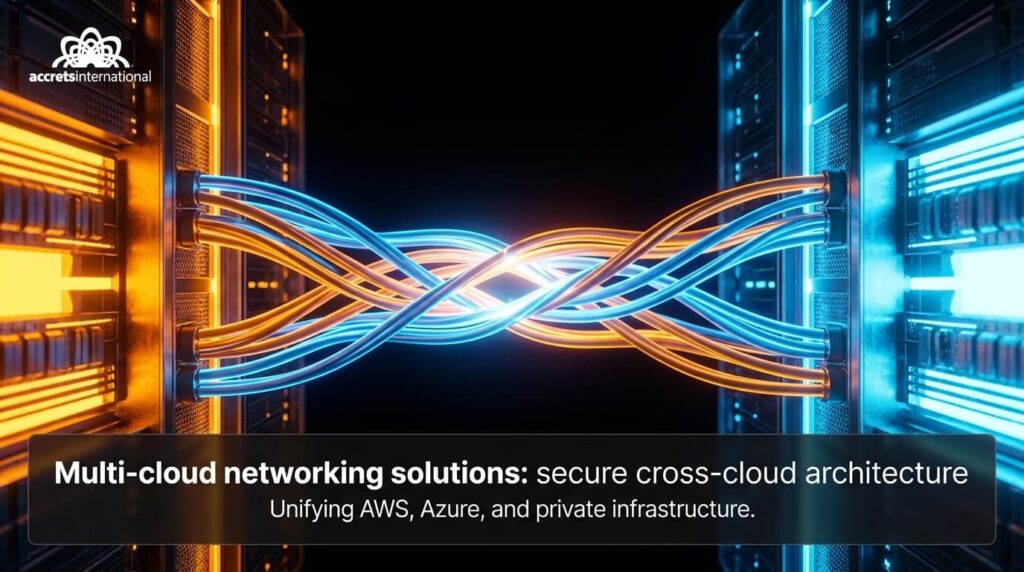

Multi-cloud networking solutions provide centralized architecture frameworks that connect, route, and secure data workloads across disparate public environments like AWS and Azure, alongside on-premises private infrastructure. By translating conflicting provider interfaces into a single unified routing domain, these solutions establish consistent encryption, granular visibility, and predictable traffic routing across your entire digital footprint. Read on to uncover the definitive blueprints and regulatory frameworks necessary for resilient enterprise network design.
TL;DR
- Multi-cloud networking connects fragmented cloud and private environments into a single secure routing domain.
- Virtual overlays offer fast deployment but face strict hypervisor compute bottlenecks.
- Physical Layer 2 exchanges inside carrier-neutral data centers deliver unthrottled throughput and lower latency.
- Proper architectural design minimizes regional data egress fees across AWS and Azure.
- Singapore based deployments require MAS TRM compliant encryption and isolated administrative tracking.
Understanding the architectural shift to multi-cloud networking
Traditional enterprise networks rely heavily on a hub and spoke model designed around a centralized physical data center. Under this legacy layout, branch offices and remote systems connect directly back to the on-premises core via multiprotocol label switching (MPLS) circuits or dedicated lines. When public clouds emerged, IT teams treated them as simple extension spokes. They terminated an individual tunnel from the data center directly into a single public virtual private cloud (VPC).
As workloads decentralized, this data center centric setup created severe backhauling issues. Forcing traffic destined for a public application to travel through an on-premises stack for security scrubbing before routing back out to the internet introduces significant latency. It also wastes physical port capacity.
Modern cross environment architecture breaks this pattern by decoupling the physical transport lines from the logical routing layer. Instead of relying on static hardware routes, it implements a software-defined overlay that operates uniformly across public platforms and private hardware. To build an environment that accommodates shifts in business layout without causing operational lock-in, engineering teams must anchor their designs on the core fundamentals of cloud computing.
Transitioning from rigid on-premises legacy links to fluid network topologies allows an organization to treat cloud resources as an adaptive grid. When selecting appropriate integration partners, working with certified hybrid cloud providers in singapore confirms that the physical network footprints align with localized low latency network paths. This provides a stable foundation for the high level software abstraction layer.
Core challenges in cross environment networking
Connecting separate IT systems introduces distinct operational obstacles. When network traffic crosses infrastructure boundaries, three technical friction points consistently appear. These are latency degradation, asymmetric security boundaries, and routing table inflation.
Transport latency and public internet tunnels
Relying on standard IPsec VPN tunnels across the public internet introduces variable performance. Public broadband routing depends on unpredictable internet service provider (ISP) peering agreements. This dependency frequently results in erratic packet routing across regional availability zones. Jitter and packet loss degrade database replication protocols between platforms. Real-time applications quickly turn into operational bottlenecks.
API disconnection and policy fragmentation
AWS, Azure, and private environments use entirely different control planes. Security groups in AWS do not natively coordinate with network security groups in Azure or firewalls in private spaces. Manually adjusting individual configuration tables across separate provider interfaces leaves clear gaps for misconfiguration. This directly impacts core cloud computing business applications that expect consistent access controls.
Inter cloud data egress fee structures
Hyperscalers charge data egress fees whenever traffic exits their infrastructure network. Uncoordinated database cross replication or unoptimized application queries crossing cloud zones quickly result in unexpected baseline expenses. Without structured routing topologies, egress fees can overtake compute costs during major data transfers or standard operational routines.
Managing these challenges requires aggressive data layout planning. Consolidating multi region environments into regional hubs helps reduce transit distances. This is a core benefit when executing thorough data centre consolidation to streamline network handoffs.
Enterprise cloud storage systems must be positioned near the primary compute blocks utilizing them to avoid data transport charges. IT teams must maintain a clear understanding of the cloud computing and cloud storage difference to optimize layout designs. Transport layers must match storage access patterns rather than blindly routing high volume read or write data blocks through long, expensive public transit links.
Enterprise network design: virtual routers compared to physical exchanges
Enterprises looking to link disparate hosting clouds must choose between two distinct transport models. They can run a software-defined overlay using virtual appliances, or they can terminate connections directly into a hardware-backed private exchange. Both approaches provide specific tradeoffs across bandwidth ceilings, deployment speed, and configuration control.
| Architectural Dimension | Software-Defined Overlay (vRouters) | Layer 2 Private Cloud Exchanges |
| API Translation Layer | Dynamic software layer; translates cloud parameters in real time | Static cross-connect paths; requires external orchestration |
| Throughput Ceilings | Capped by virtual appliance compute limits (typically 1 to 10 Gbps per tunnel) | Line-rate performance (10 Gbps to 100+ Gbps unthrottled) |
| Routing Convergence | Accelerated via software overlays; immediate automated failover | Dependent on physical hardware BGP hold times and convergence loops |
| Encryption Scenarios | Native IPsec/TLS termination at the virtual instances | Requires external hardware appliances to encrypt the underlying fiber |
| Multi-Tenant Isolation | Virtual routing and forwarding (VRF) instances inside hypervisors | Physical port isolation and dedicated VLAN tagging segments |
Software overlays use virtual router instances deployed directly inside each public cloud network. This methodology allows rapid setup since teams can provision infrastructure templates across regions in minutes. However, these virtual engines are strictly limited by hypervisor compute boundaries. Processing high volume workloads through intensive packet inspection routines can saturate virtual CPUs. This introduces micro stalls and packet drops under heavy load.
Conversely, routing data via private cloud exchanges shifts the data transit path completely off the public internet. By establishing physical fiber cross-connects inside carrier-neutral facilities, enterprises achieve low latency and line rate performance. Mapping these relationships correctly helps engineers understand how data travels between systems.
Enterprises can clarify these options by analyzing how to structure understanding the interoperability of inter-cloud services to prevent connectivity bottlenecks. When legacy application data must stay isolated on dedicated bare metal due to security guidelines, determining what are private cloud hosting services allows teams to confidently blend specialized hardware storage clusters with high scale public front ends through deterministic, non internet transport pipelines.
Connecting AWS Transit Gateway and Azure Virtual WAN to private cages
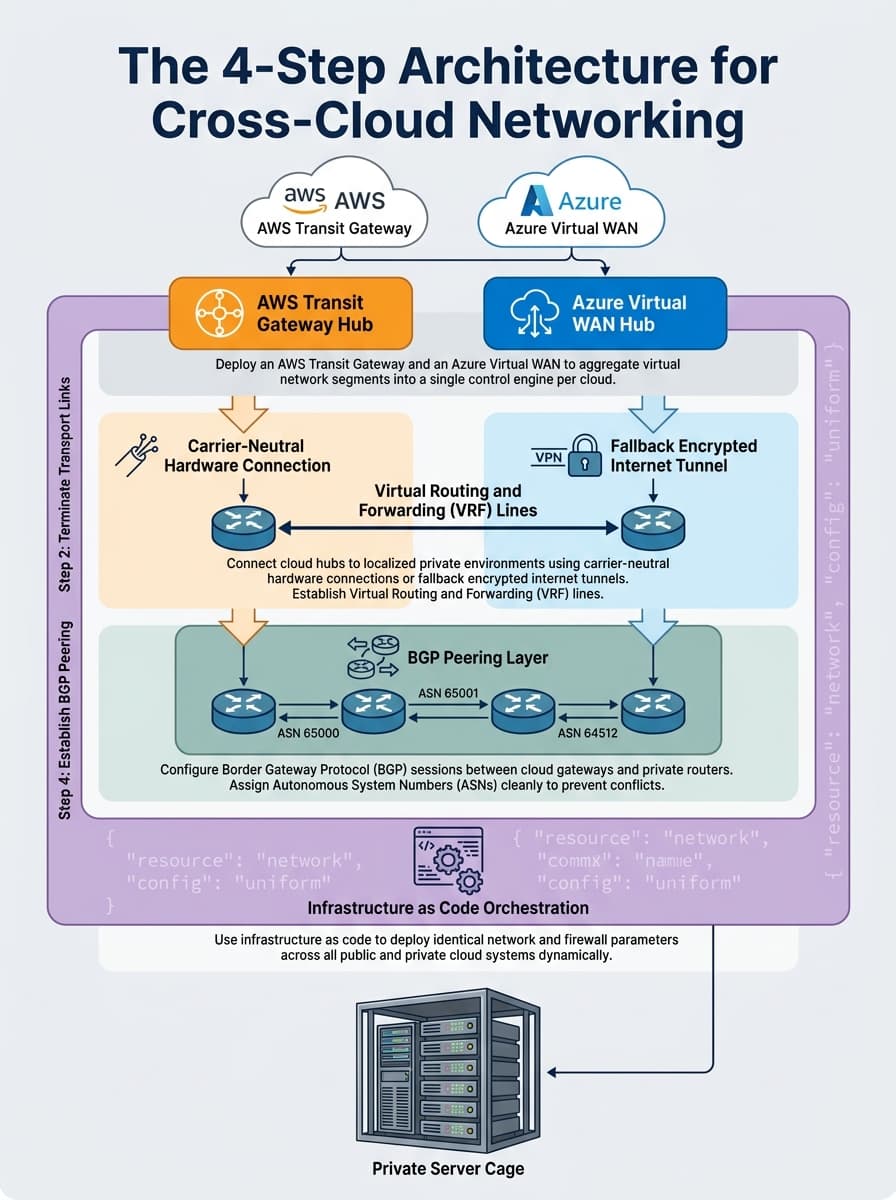
Building a resilient cross environment network requires establishing clean boundaries between public cloud transit engines and physical private equipment. A common deployment standard utilizes automated script pipelines to handle cross cloud architecture patterns. This links public cloud transit systems to custom physical server clusters.
- Scoping cloud hub boundaries: The integration process starts by configuring the centralized routing hubs inside each public cloud environment. In AWS, this means deploying an AWS Transit Gateway to unify separate VPC networks across accounts. In Azure, a corresponding Azure Virtual WAN hub is established to aggregate public virtual network segments into a single control engine.
- Terminating transport links: Transport links must connect the cloud hubs to the localized private environment. This path uses either high throughput hardware connections terminated inside a carrier-neutral facility or fallback encrypted internet tunnels. Virtual routing and forwarding (VRF) lines are established on the physical equipment to segment testing environments from live databases.
- Establishing BGP peering parameters: Dynamic routing across public and private spaces requires configuring Border Gateway Protocol (BGP) peering sessions between cloud gateways and private routers. Autonomous System Numbers (ASNs) must be assigned cleanly across environments to prevent configuration conflicts. Engineers use explicit path settings, like BGP path prepending, to stop traffic from routing through slower backup connections.
- Deploying automated orchestration templates: To maintain consistent environments, the setup uses infrastructure as code models to deploy network parameters across public cloud systems. Teams must carefully maneuver the technical boundaries between code automation and hardware resources by examining infrastructure as code vs infrastructure as a service. Automating configuration updates prevents manual configuration errors. This approach means firewall modifications deploy identically everywhere. Applying the core advantages of infrastructure as a service allows infrastructure teams to scale virtual networks on demand. Connection parameters become code definitions that spin up or scale down dynamically as production workloads shift between locations.
Data sovereignty and regulatory compliance for Singapore enterprise networks
Enterprises operating within Singapore or utilizing Singapore based infrastructure must align their multi-cloud architectures with strict domestic regulatory frameworks. The Personal Data Protection Act (PDPA) and the Monetary Authority of Singapore (MAS) Technology Risk Management (TRM) Guidelines impose clear requirements on data transit encryption, system auditability, and access control boundaries.
Under MAS TRM regulations, financial entities and their critical service providers must demonstrate total infrastructure resilience. This requires implementing end-to-end data encryption for all personal info traveling over public networks or unmanaged lines. Multi-cloud network designs must explicitly separate data tracking logs from the underlying payload traffic. This separation stops administrative tasks from exposing unencrypted production text to third party monitoring platforms.
Peering connections across providers require high encryption standards. Organizations can build compliant frameworks by reviewing infrastructure security in cloud computing. For regulated fields like fintech or regional banking, infrastructure managers should verify compliance trends by examining cloud banking solutions. This confirms connection tracking maps cleanly to current central bank audit standards.
When cross border connections or multiple cloud handoffs add administrative overhead, engaging qualified cloud security consulting services provides the verified testing and risk documentation needed to pass strict industry audits without delaying production software launches.
Transitioning from complex architecture to managed operations
Designing a secure multi-cloud system demands deep infrastructure insight and precise engineering coordination. While software-defined layers offer an abstraction layer, the absolute performance of any enterprise network still depends on its real physical connections, routing configurations, and compliance boundaries. Shifting internal IT staff from strategic development work to manage multi-cloud networking tables often results in high support overhead and unresolved configuration errors.
For global enterprises operating out of regional data hubs, managing this infrastructure complexity requires an experienced deployment partner. Accrets designs, implements, and operates high performance multi-cloud networking architectures tailored to actual business demands. This avoids hyperscaler over-provisioning or arbitrary provider dependencies. By terminating cross environment connections inside carrier-neutral data centers, Accrets provides stable, high throughput network configurations that safely connect AWS, Azure, and custom private servers.Enterprise network managers can optimize infrastructure layers and clear away hidden egress costs by relying on dedicated infrastructure engineers. To design a secure network configuration built for performance and compliance, talk to an infrastructure specialist at Accrets to analyze your multi-cloud network requirement.

Dandy Pradana is an Digital Marketer and tech enthusiast focused on driving digital growth through smart infrastructure and automation. Aligned with Accrets’ mission, he bridges marketing strategy and cloud technology to help businesses scale securely and efficiently.