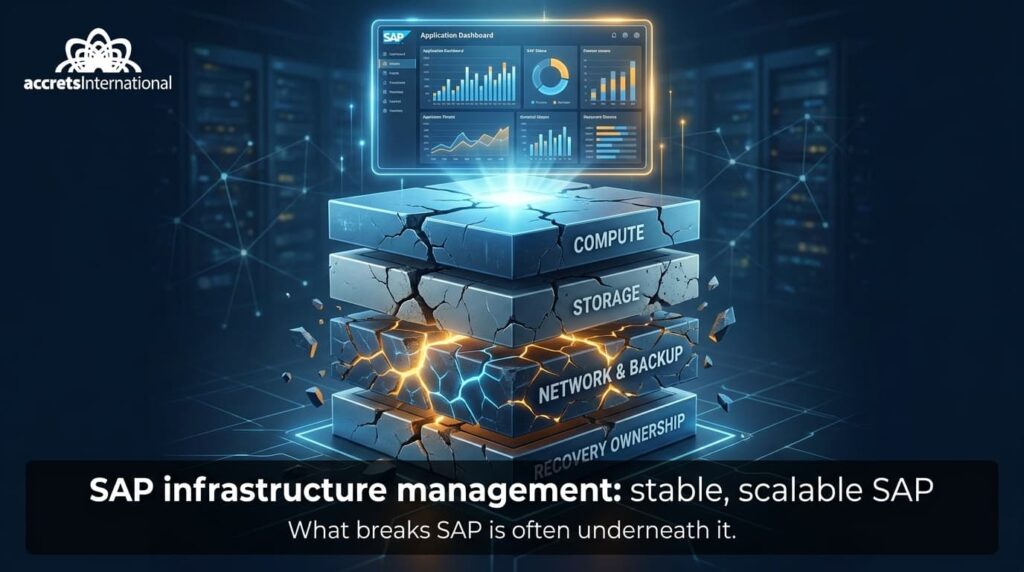

SAP infrastructure management keeps SAP environments stable by managing the compute, storage, network, backup, monitoring, security, and recovery layers that SAP depends on every day. In this guide, we will walk through the core components, how SAP infrastructure differs from SAP Basis, what to evaluate before outsourcing, and where Accrets fits for Singapore and APAC enterprises.
TL;DR
- SAP infrastructure management covers compute, storage, network, backup, monitoring, security, high availability, and disaster recovery.
- SAP Basis manages the SAP technical layer, while infrastructure management keeps the underlying platform stable and recoverable.
- Generic cloud management is not always enough for SAP because SAP workloads have specific dependencies around HANA, interfaces, backup windows, and recovery.
- Enterprises should evaluate uptime, RTO, RPO, backup validation, SAP hosting capability, escalation ownership, and provider accountability.
- Accrets supports Singapore enterprises with SAP hosting, SAP Basis managed services, managed private cloud, backup, DR, monitoring, and infrastructure operations.
What is SAP infrastructure management?
SAP infrastructure management is the discipline of managing the technical environment that supports SAP applications, including servers, storage, networks, backup, monitoring, security controls, and lifecycle operations.
That sounds simple until you look at what SAP actually depends on. A production SAP environment is not just one application. It may include application servers, databases, SAP HANA, operating systems, virtual machines, storage tiers, network routes, backup jobs, security controls, and disaster recovery processes.
SAP infrastructure management keeps those layers coordinated. When it is done well, users experience a stable SAP system. When it is done poorly, the business sees slow transactions, failed jobs, missed backup windows, unplanned downtime, or unclear ownership when something breaks.
This is broader than hosting. Hosting gives SAP somewhere to run. Infrastructure management makes sure that environment remains available, recoverable, secure, and sized for the business.
For a wider foundation on how these layers fit together, Accrets’ guide to IT infrastructure management services explains the broader enterprise infrastructure context.
The core components of SAP infrastructure management
Most decision-makers start with a practical question: what does SAP infrastructure management include?
The short answer is compute, storage, network, and backup. The more complete answer includes security, monitoring, high availability, disaster recovery, patching, capacity planning, and service ownership.
| Component | What it includes | SAP-specific concern | Management responsibility |
| Compute | CPU, memory, virtual machines, operating systems, high availability | SAP application server sizing, SAP HANA memory needs, workload peaks | Capacity planning, patching, monitoring, scaling |
| Storage | Performance tiers, capacity, snapshots, replication, backup targets | HANA storage latency, database growth, backup windows | Storage design, monitoring, expansion, recovery testing |
| Network | Connectivity, firewall rules, segmentation, VPN, latency, user access | Interface stability, user response time, secure remote access | Network monitoring, secure changes, incident support |
| Backup | Schedules, retention, restore testing, DR copies | SAP-consistent backup, RTO, RPO, database recovery | Backup policy, success checks, restore testing, reporting |
Compute: CPU, memory, virtual machines, and high availability
Compute is where SAP workloads run. It includes physical or virtual servers, CPU allocation, memory, operating systems, clustering, and high availability design.
For SAP HANA, memory planning matters. For SAP application servers, workload peaks matter. A system that runs smoothly at 10 a.m. may struggle during month-end closing, batch processing, or regional reporting cycles.
Storage: capacity, performance, snapshots, and replication
Storage is not only about capacity. SAP environments need predictable storage performance, clear growth planning, and recovery mechanisms that match business expectations.
SAP HANA and database workloads can be sensitive to latency. Backup targets, snapshots, replication, and archive policies all need to be designed around restore requirements, not just storage cost.
Network: connectivity, segmentation, firewall rules, and latency
Network design affects user experience, integration stability, and security. A slow or unstable network can look like an SAP performance issue even when the application itself is healthy.
SAP environments often connect to offices, warehouses, finance systems, third-party applications, remote users, and cloud services. That means routing, firewall rules, VPN access, segmentation, and monitoring need careful ownership.
Backup: schedules, retention, restore tests, RTO, and RPO
Backups only matter if they restore. A backup job that reports “successful” is not the same as a tested recovery plan.
SAP backup management should define retention, backup frequency, recovery time objective, recovery point objective, restore testing, and escalation when a backup fails. If SAP supports critical finance, operations, inventory, or customer processes, backup and disaster recovery cannot sit at the edge of the infrastructure plan.
Accrets covers this broader resilience discipline in its guide to building a backup and disaster recovery plan.
How SAP infrastructure management differs from SAP Basis
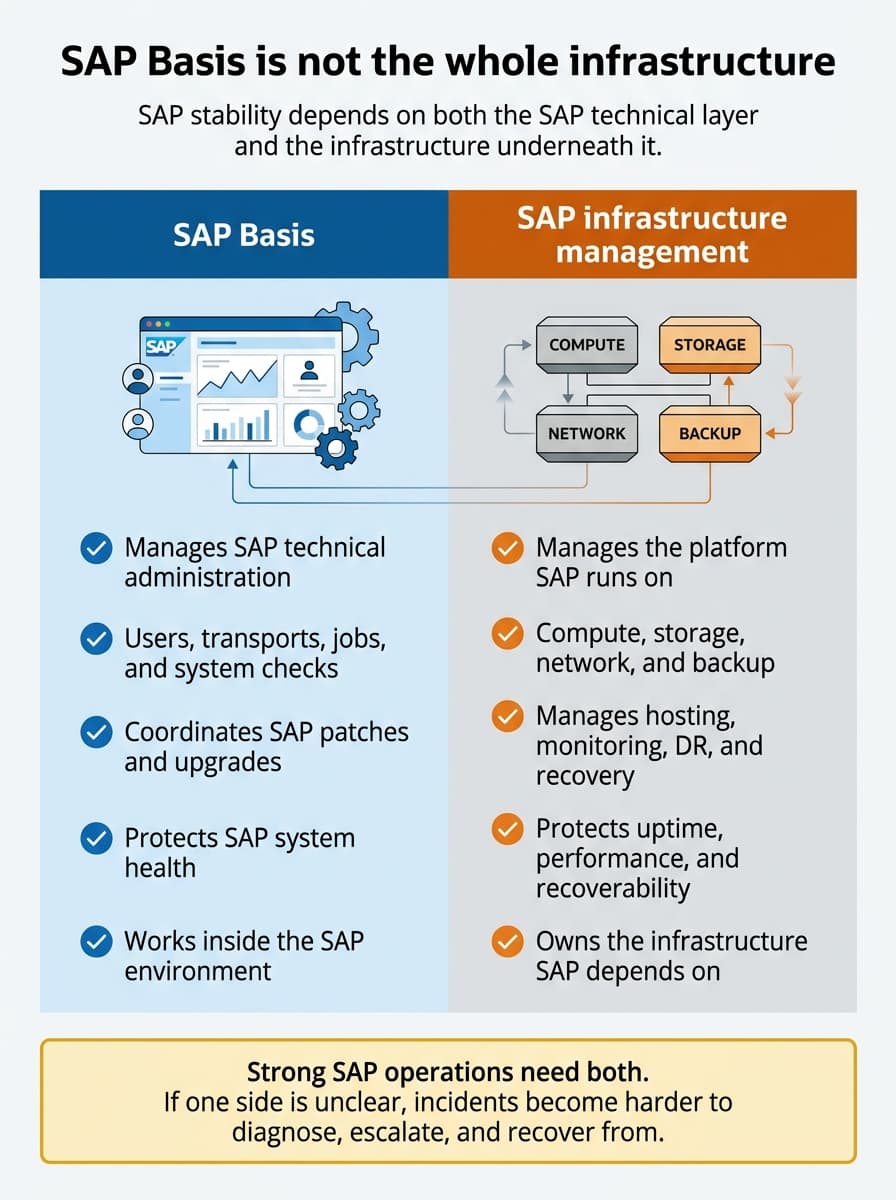
SAP Basis is the technical administration layer that connects SAP applications with databases, operating systems, users, transports, jobs, and system monitoring.
SAP Basis and infrastructure management overlap, but they are not identical. Basis focuses on the SAP technical layer. Infrastructure management focuses on the platform that keeps that SAP layer running.
| Area | SAP Basis | SAP infrastructure management |
| Main focus | SAP technical administration | Infrastructure availability, security, recovery, and performance |
| Typical work | Transports, users, jobs, system checks, patch coordination | Compute, storage, network, backup, monitoring, DR, hosting |
| Business outcome | SAP system health and application continuity | Stable platform for SAP workloads to run and scale |
In practice, the two teams need to work closely. A database patch may require Basis coordination. A storage issue may appear as SAP slowness. A network change may affect interfaces. A disaster recovery test may require both infrastructure recovery and SAP validation.
The real issue is not whether SAP Basis or infrastructure owns everything. The issue is whether ownership is clear before an incident happens.
Why generic cloud management is not enough for SAP
SAP-aware infrastructure management is infrastructure management that understands SAP-specific dependencies such as HANA performance, application servers, transport timing, backup windows, interfaces, and recovery requirements.
Generic cloud management can tell you whether a server is up. SAP-aware management asks a better question: is the SAP landscape healthy enough for the business process it supports?
That distinction matters. An infrastructure dashboard might show that compute, storage, and network are available. Yet users may still face slow transactions, failed batch jobs, locked interfaces, or database pressure. The cloud platform is alive, but the SAP service is not performing.
This is why SAP buyers ask more than “which cloud should we use?” They also ask:
- Can the provider understand SAP HANA performance requirements?
- Can they coordinate infrastructure maintenance with SAP Basis?
- Can they support system copies, patching, and upgrade windows?
- Can they monitor backup success and restoration readiness?
- Can they explain where SAP, the customer, and the managed provider each take responsibility?
A general cloud operations model may work for standard web workloads. SAP needs cloud operations that understand enterprise application dependency. Accrets’ article on cloud operations management is useful background for teams comparing generic infrastructure operations with SAP-aware operations.
SAP infrastructure operating models compared
Enterprises usually compare several operating models before choosing how to run SAP infrastructure. The right answer depends on internal skills, risk tolerance, compliance needs, budget model, and how critical SAP is to daily operations.
| Model | Best fit | Strength | Risk or limitation |
| Internal SAP Basis and infrastructure team | Large enterprises with mature IT operations | High internal control | Requires deep SAP, cloud, security, and DR expertise |
| Generic cloud infrastructure management | Companies with mostly non-SAP workloads | Strong cloud tooling and scalability | May miss SAP-specific dependencies |
| RISE with SAP | Companies standardizing transformation through SAP-led model | Simplified commercial model for SAP transformation | Operating boundaries must be understood clearly |
| Managed SAP infrastructure provider | Enterprises needing accountable operations support | Clearer ownership for infrastructure, backup, monitoring, and DR | Requires careful SLA and responsibility definition |
| Hybrid model | Companies with mixed SAP and non-SAP systems | Flexible transition path | Governance can become fragmented |
Internal teams can work well when the company has mature Basis, infrastructure, security, and DR capabilities. The challenge is staffing. SAP operations need depth, and many IT teams are already stretched across cloud, security, end-user support, compliance, and business projects.
Private cloud and hybrid cloud models can give enterprises more control over performance, connectivity, and data placement. Accrets’ guide to private cloud hosting services explains why some businesses still prefer dedicated environments for sensitive or mission-critical workloads.
Hybrid models are common when companies are modernizing gradually. Some SAP systems may remain on private infrastructure while other workloads move to public cloud or SaaS. For teams operating across Singapore and the region, this guide to hybrid cloud providers in Singapore gives a useful decision framework.
The most important point is not the label. It is accountability. Someone must own uptime, backup validation, incident response, capacity planning, security baseline, and disaster recovery readiness.
What enterprises should evaluate before choosing a SAP infrastructure partner
A SAP infrastructure partner should not only sell infrastructure. The partner should help you understand operating risk.
Before signing, ask specific questions:
- What exactly does the provider manage: compute, storage, network, backup, SAP Basis, or all of them?
- What are the SLA terms for uptime, response time, and escalation?
- How are backup success, restore tests, RTO, and RPO reported?
- Does the provider support SAP HANA performance requirements?
- How are patches, changes, and maintenance windows coordinated?
- Can the provider support private cloud, hybrid cloud, or multi-cloud architecture?
- What proof exists for SAP hosting capability, DR testing, or enterprise infrastructure operations?
RTO and RPO deserve special attention. RTO is how quickly the business expects the SAP service to be restored after disruption. RPO is how much data loss the business can tolerate. These are business decisions first, then infrastructure design decisions.
Cost should also be reviewed honestly. Self-managed infrastructure may look cheaper until you include internal labour, after-hours support, licensing, backup tooling, DR testing, monitoring, security controls, and downtime risk. Accrets’ guide on choosing a managed cloud services provider covers many of the provider evaluation questions that also apply to SAP infrastructure.
How Accrets supports SAP infrastructure management for Singapore enterprises
Accrets is a Singapore-based infrastructure partner focused on private cloud, hybrid cloud, multi-cloud, connectivity, disaster recovery, managed IT, and SAP hosting services. Its brand position is consultative: design the environment around the business requirement first, then manage the infrastructure through operations, monitoring, backup, and recovery.
For SAP environments, Accrets’ SAP Hosting and Basis Managed Services include SAP-certified hosting infrastructure, SAP Business One hosting and administration, SAP Basis managed services, performance tuning, patching, upgrades, high availability configuration, and 24/7 SAP infrastructure monitoring and support.
That makes Accrets relevant when a company needs more than server hosting. The need is usually broader: stable SAP infrastructure, accountable managed operations, backup validation, disaster recovery planning, and a local team that understands enterprise infrastructure risk.
| Area | Customer team | SAP Basis team | Managed infrastructure provider |
| Business requirements | Defines priorities | Validates SAP impact | Designs infrastructure support |
| Compute and hosting | Approves capacity needs | Advises SAP sizing impact | Manages hosting, capacity, monitoring |
| Storage and backup | Defines retention needs | Coordinates SAP consistency | Manages backup jobs, storage, restore testing |
| Network and access | Defines users and sites | Validates SAP connectivity | Manages routing, firewall, VPN, latency support |
| Monitoring and incidents | Prioritizes business impact | Diagnoses SAP layer | Monitors infrastructure and escalates incidents |
| DR planning | Defines RTO and RPO | Validates SAP recovery | Operates DR infrastructure and rehearsals |
Accrets’ differentiators include SAP hosting services certification, vendor-agnostic architecture, Equinix-partnered carrier-neutral infrastructure, rehearsal-led disaster recovery, and full-stack managed delivery across design, migration, connectivity, monitoring, backup, DR, and application-layer support.
For readers comparing service areas, Accrets provides dedicated pages for IT infrastructure solutions, managed backup services, IT DR as a Service, and managed IT services. SAP Business One users can also review Accrets’ SAP Business One solution.
Accrets is not the answer for every SAP environment. A large enterprise with a mature internal SAP infrastructure team may prefer to keep operations in-house. A company moving fully into a SAP-led transformation model may evaluate RISE with SAP. The fit is strongest when the business wants accountable managed infrastructure, local Singapore support, SAP hosting capability, and a partner that can operate across private cloud, hybrid cloud, backup, DR, and connectivity.
SAP infrastructure readiness checklist before migration or outsourcing
Before speaking with a provider, prepare the details that shape the infrastructure design. This avoids vague scoping and helps the provider give a practical recommendation.
- Current SAP version and landscape map
- Database type, especially SAP HANA if applicable
- Number of users, peak workload periods, and critical interfaces
- Current compute, storage, network, and backup setup
- Current incident history and performance pain points
- Backup schedule, retention policy, RTO, and RPO
- DR test history and recovery expectations
- Security, compliance, and reporting requirements
- Cloud, private cloud, on-premise, or hybrid preference
- Internal team responsibilities and escalation paths
If you are still estimating future resource needs, Accrets’ guide to IT infrastructure capacity planning can help frame the conversation.
For migration planning, use a structured checklist before changing the environment. Accrets also provides a cloud migration plan template and an IT disaster recovery plan template for teams that need to document the process.
Keep SAP stable by managing the infrastructure around it
SAP performance, uptime, and recovery are not only application issues. They depend on decisions across compute, storage, network, backup, monitoring, security, disaster recovery, and service ownership.
If your SAP environment is becoming harder to manage, or if the business needs clearer accountability for uptime and recovery, speak with Accrets about your current operating model. Accrets’ content strategy includes SAP and enterprise applications as a pillar for SAP-dependent enterprises evaluating hosting and managed services options.Talk to an infrastructure specialist to review your SAP infrastructure management approach and identify where stability, scalability, or recovery gaps may exist.

Dandy Pradana is an Digital Marketer and tech enthusiast focused on driving digital growth through smart infrastructure and automation. Aligned with Accrets’ mission, he bridges marketing strategy and cloud technology to help businesses scale securely and efficiently.