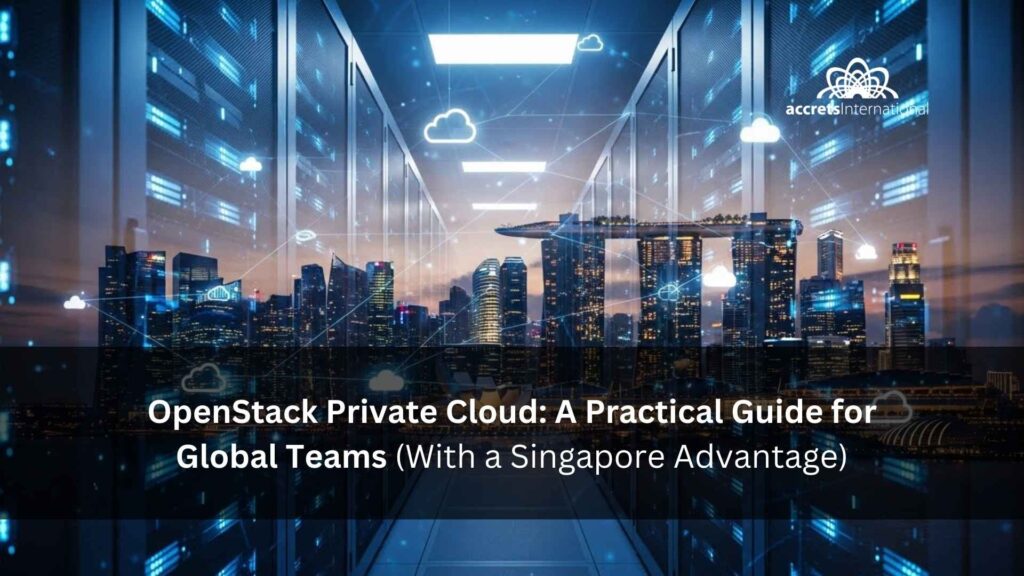

If you are asking “what is an OpenStack private cloud and is it right for us,” the short answer is: it is a private cloud built with open source OpenStack that gives you public cloud style APIs on dedicated infrastructure, more control over data and cost, and a strong fit for regulated or latency sensitive workloads, especially when hosted in strategic hubs like Singapore. In this guide we will walk through what it is, how it works, when to choose it over public cloud or VMware, typical use cases, migration paths, and how a partner like Accrets can help, so you can read on with confidence and make a well informed decision by the end.
If you are looking at OpenStack, chances are you are at an inflection point.
Public cloud bills are creeping up. VMware licensing and support are getting complicated. Compliance and data residency are getting stricter. And now the phrase OpenStack private cloud keeps popping up in boardroom decks and architecture diagrams.
This guide is for CIOs, CTOs, IT architects and operations leaders who want a clear, practical view of what OpenStack private cloud actually is, when it makes sense, and how it fits into a global or Asia-Pacific strategy, especially if Singapore is part of your footprint.
We will stay vendor-neutral for most of the article. Only at the end will we talk about how Accrets can help you design, build, or manage OpenStack private cloud environments in Singapore and beyond.
What Is an OpenStack Private Cloud? (In Plain Language)
Let us strip away the jargon.
OpenStack is an open source cloud operating system. It lets you pool compute, storage, and networking resources in your data centers and expose them through APIs and self service portals, similar to how AWS or Azure work in their public cloud platforms.
A private cloud is simply cloud style infrastructure where the resources are dedicated to one organisation. It can live:
- On premises in your own racks
- In a colocation facility
- With a trusted provider that hosts and manages it for you
So an OpenStack private cloud is a private cloud environment built using OpenStack components, giving you:
- Public cloud like APIs and automation
- Dedicated infrastructure and custom policies
- The flexibility to run in your own data centres or in a partner environment
If you are still firming up your understanding of private cloud models, you might find it useful to look at how businesses are adopting private cloud hosting services and why they prefer them in 2025 as part of a broader hybrid strategy.
Why Choose OpenStack for Private Cloud Instead of Public Cloud or VMware?
When teams search for “OpenStack private cloud”, they are usually comparing three paths:
- Stay or go deeper into public cloud
- Double down on traditional virtualisation (for example VMware)
- Move toward open, cloud native private infrastructure with OpenStack
OpenStack vs Public Cloud
Public cloud shines for elasticity and global reach. But as workloads grow, many organisations feel pain around:
- Unpredictable costs: compute, storage, and especially egress fees
- Data residency and sovereignty: sensitive data may need to stay within specific jurisdictions
- Customisation limits: you are constrained by the provider services and guardrails
With an OpenStack private cloud, you can:
- Keep data within specific regions or data centres, which is critical for regulated workloads
- Design your own performance tiers and network topologies
- Control long term TCO with predictable infrastructure and support models
If you are evaluating regional hosting options, the trade offs between cloud infrastructure in Singapore and Southeast Asia are similar to what is explored in this Singapore cloud VPS field guide for US buyers.
OpenStack vs Traditional VMware Environments
A VMware based environment is a solid starting point, but it is primarily a virtualisation platform, not a full cloud platform. You can bolt cloud like features on top, but it was not originally built with cloud native scale and automation in mind.
OpenStack offers:
- API first design for provisioning and automation
- A rich ecosystem of integrations for storage, networking, and containers
- An open, community driven roadmap, not tied to a single vendor licensing model
For organisations reviewing their strategy, it is worth exploring VMware alternatives and mapping them to your digital transformation plans, as in this VMware digital transformation playbook.
When OpenStack Is Not a Good Fit
Being honest is important: OpenStack is not a magic solution for everyone.
It may not be ideal if:
- You have only a handful of VMs and no plan to grow
- You lack any internal or partner access to Linux or cloud engineering skills
- You want zero operational responsibility and are happy to pay a premium for full public cloud managed services
In those cases, managed public cloud or a simpler virtualisation stack might be more appropriate.
Inside an OpenStack Private Cloud: Core Architecture & Components
At a high level, an OpenStack private cloud is made up of several core services working together:
- Keystone: identity and access management
- Nova: compute (virtual machines)
- Neutron: software defined networking (subnets, routers, floating IPs, and similar)
- Cinder: block storage for VMs
- Glance: image service for VM templates
- Horizon: the web dashboard for self service management
On top of this, you often see:
- Ceph or other distributed storage solutions backing Cinder or object storage
- Advanced Neutron plugins or SDN controllers for complex networking
Because OpenStack exposes standard APIs, it plays well with container platforms. Many teams run:
- Kubernetes clusters on top of OpenStack VMs
- Or use OpenStack to provide persistent storage and networking for container platforms
If you are still building your mental model around cloud architectures, stepping back to the fundamentals of cloud computing and then looking at how to build cloud computing infrastructure without wrecking your budget or security can be surprisingly helpful.
High Availability and Scaling
In production environments, you do not just deploy one controller. You design for:
- Redundant controller nodes
- Separate data and control planes
- Multiple compute nodes for capacity and fault tolerance
This is where an experienced partner or in house team makes a big difference: OpenStack flexibility is powerful, but poor design at this layer leads directly to instability and painful outages.
Is OpenStack Private Cloud Right for Your Organization? (Decision Framework)
Let us walk through a quick practical framework.
Questions for CIOs and CTOs
- Do you need greater control over where your data lives and how your infrastructure is configured?
- Are public cloud costs becoming a board level topic?
- Are there workloads you cannot move to public cloud due to regulatory or latency constraints?
If you are planning multi year capacity and spend, it is worth pairing this decision with formal IT infrastructure capacity planning and understanding your corporate IT infrastructure blueprint in Singapore if Singapore is a key region.
Questions for Architects
- Do you need cloud style APIs and automation on dedicated hardware?
- Do you already use or plan to use Kubernetes, CI or CD pipelines, or infrastructure as code toolchains?
- Do you require interoperability across multi cloud or on prem plus cloud combinations?
Understanding the interoperability of inter cloud services across different platforms can help you decide whether OpenStack becomes your central cloud control plane or one of several.
Questions for Operations and SRE Teams
- Do you have (or can you access) engineers who are comfortable with Linux, networking, and distributed systems?
- Are you prepared to manage monitoring, patching, and lifecycle operations, or do you want that offloaded to a managed service provider?
If the answers lean toward control, regulatory needs, and medium to large scale, OpenStack private cloud is worth serious consideration.
Build vs Buy: DIY OpenStack vs Managed or Hosted Private Cloud
Once you have decided that OpenStack private cloud is attractive, the next question is how you get there.
DIY OpenStack
In a DIY model, you:
- Design the architecture
- Procure hardware and networking
- Install and configure OpenStack
- Handle all upgrades, patches, monitoring, and incident response
You get maximum control, but you also carry maximum risk and operational overhead. Teams often underestimate the ongoing effort, treating OpenStack as a one time project instead of a living platform.
Managed or Hosted OpenStack Private Cloud
In a managed or hosted model, a specialist provider handles:
- Design and deployment of the OpenStack environment
- Day to day operations, monitoring, and patching
- SLAs for uptime and response
- Capacity planning and lifecycle upgrades
You still benefit from private, dedicated resources, but without building a large internal OpenStack team from scratch. This aligns closely with the advantages that organisations see in infrastructure as a service, and often overlaps with what a solid managed cloud service provider delivers.
If you are still deciding how much responsibility you want to carry internally, articles like managed vs cloud services – the difference and which do you need? and the top benefits of managed cloud services for modern businesses can help quantify the trade offs.
Key Use Cases: From Banking to Government and SaaS Platforms
OpenStack private cloud is not just a technical toy, it has very real business use cases.
Financial Services and Banking
Banks and financial institutions care deeply about compliance, data residency, and uptime. An OpenStack private cloud lets them:
- Keep core workloads in controlled environments
- Integrate with on prem systems and GCC or other government clouds
- Maintain strict network segmentation and auditing
If you are in this space, the specifics in cloud banking solutions for financial institutions in Singapore and Southeast Asia and accelerating digital transformation in banking are particularly relevant.
Government and Public Sector
Governments are under pressure to modernise while maintaining sovereignty and citizen trust. OpenStack private cloud can sit alongside initiatives like Singapore government digital transformation and GCC government cloud in Singapore as part of a larger “cloud smart” strategy.
SaaS and Technology Companies
For SaaS providers, OpenStack private cloud:
- Provides consistent performance and predictable cost on dedicated hardware
- Supports multi region deployments with careful design
- Allows them to use Kubernetes and other modern patterns on top of reliable infrastructure
Real world stories usually combine elements of all three: a SaaS product serving banking customers, or a govtech platform aiming for both public cloud and private deployments.
Designing for Security, Compliance, and Reliability
No serious OpenStack private cloud conversation can avoid security and compliance.
Security Fundamentals
At a minimum, you will want:
- Strong identity and access management with Keystone
- Segmented networks using Neutron, security groups, and firewalls
- Encryption at rest and in transit where appropriate
- Centralised logging and monitoring
A good starting point is to think in terms of infrastructure security in cloud computing with a Singapore first multicloud playbook and then translate those patterns into your OpenStack design.
Compliance and Governance
If you operate in or through Singapore, you will often need to align with:
- PDPA for data protection
- MAS TRM and relevant notices if you are in financial services
- Sector specific guidelines and internal audit requirements
An OpenStack private cloud does not automatically make you compliant, but it gives you the control you need to design compliant architectures.
Reliability, Data Centre Tiers and DR
Where your OpenStack private cloud physically lives matters. Many organisations choose facilities that align with Tier 3 or higher expectations, similar to what is discussed in Tier 2 data centres in Southeast Asia and when US companies should choose Singapore and in your deeper Tier 3 and Tier 4 content.
On top of that, you should integrate:
- Regular backups and tested restores
- Clear RPO and RTO targets
- A disaster recovery design, potentially tying into cloud computing service providers in Singapore for backup and DR or dedicated DR as a service offerings.
Why Location Matters: Singapore as a Strategic Hub for OpenStack Private Cloud
From a global perspective, Singapore has become a natural hub for OpenStack based private clouds serving Asia Pacific.
You get:
- Low latency into major Southeast Asian markets
- A mature ecosystem of carriers, peering, and cloud on ramps
- Political and economic stability
- A strong regulatory regime that many international businesses already understand
For US and European organisations expanding east, the rationale is similar to the thinking behind choosing Singapore for cloud VPS and infrastructure: speed, stability, and compliance friendliness in one package.
When you combine that with robust local IT ecosystems and digital transformation service providers in Singapore, Singapore becomes more than a hosting location, it becomes a strategic platform.
Planning Migration: From VMware or Legacy Environments to OpenStack Private Cloud
Most organisations do not start on a greenfield. They start with VMware farms, legacy bare metal systems, or a patchwork of both.
Common Migration Steps
- Discover and classify workloads: which apps are stateful, which are latency sensitive, which have regulatory constraints.
- Design target architecture: how those workloads map to OpenStack flavours, networks, and storage.
- Run pilots and test migrations: start with non critical systems and refine your patterns.
- Plan cutover and rollback: define downtime windows and emergency procedures.
If you are staying on VMware for part of your estate while introducing OpenStack, practical guidance such as how to migrate a VMware VM to another host safely with or without vMotion can inform your migration patterns and risk mitigation plans.
Hybrid and Multi Cloud Patterns
Very few enterprises are “OpenStack only” or “public cloud only”. In reality, you will likely run:
- OpenStack private cloud for sensitive, predictable, or heavy workloads
- Public cloud for SaaS services, burst capacity, or global front ends
- Possibly edge locations for ultra low latency use cases
In that world, guides to hybrid cloud providers in Singapore and inter cloud interoperability become more and more relevant, because your OpenStack private cloud is one critical piece of a larger puzzle.
How Accrets Can Help With Your OpenStack Private Cloud Strategy
If you have read this far, you are likely serious about OpenStack private cloud, or you are trying to decide if you should be.
Accrets is a Singapore based but globally minded cloud and infrastructure partner that helps organisations:
- Evaluate whether OpenStack private cloud is the right fit
- Design reference architectures aligned with your compliance, performance, and cost constraints
- Build or migrate from VMware and legacy environments into modern private cloud platforms
- Operate and support OpenStack based environments with clear SLAs, monitoring, and lifecycle management
- Integrate with public clouds and DR solutions using services like cloud infrastructure as a service, on premise private cloud, managed backup services, and managed IT services
If you want to explore what this looks like for your organisation, the next step is simple:
Fill the form below for free consultation with Accrets Cloud Expert for OpenStack private cloud
You will talk to someone who can translate business requirements into architecture options, not just pitch a generic cloud package.

Dandy Pradana is an Digital Marketer and tech enthusiast focused on driving digital growth through smart infrastructure and automation. Aligned with Accrets’ mission, he bridges marketing strategy and cloud technology to help businesses scale securely and efficiently.