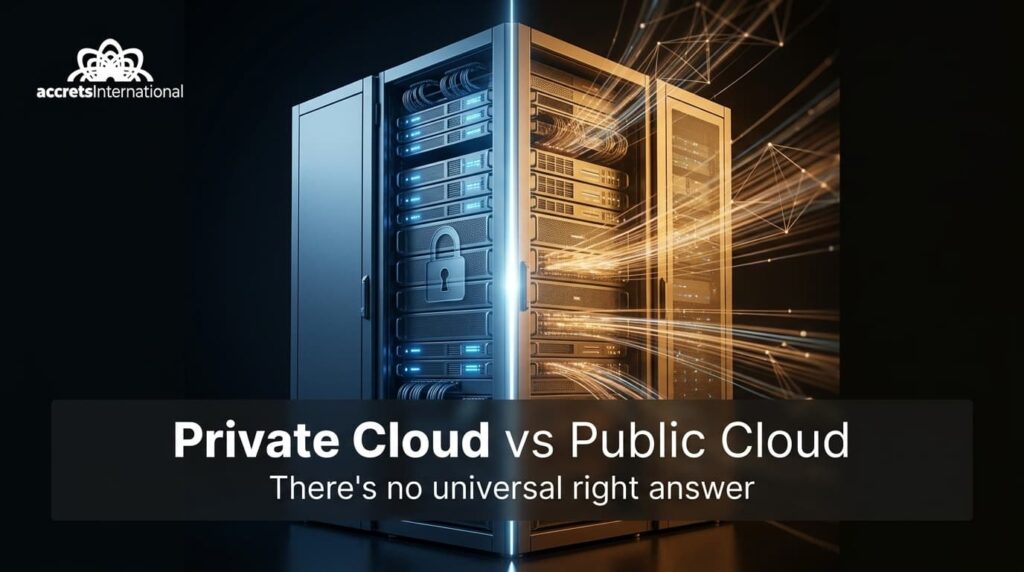

Most teams ask “private cloud or public cloud” as if it only had one right answer. It doesn’t. The honest answer depends on what the workload actually needs: how sensitive the data is, how predictable the traffic is, who has to answer for it during an audit, and who is actually available to run it day to day.
This guide walks through the real differences, shows which workloads tend to land where, and gives you a framework to make the call for your own environment rather than borrowing someone else’s default.
The short version:
- Public cloud wins on speed, elastic scaling, and low setup cost for unpredictable workloads.
- Private cloud wins on control, data residency, and predictable cost for stable, regulated, or performance-sensitive systems.
- Neither model is automatically cheaper or automatically more secure. That depends on how it’s architected and operated.
- Most mid-size and enterprise environments end up running both, deliberately, not by accident.
What private cloud and public cloud actually mean
The difference comes down to tenancy. Public cloud runs on infrastructure shared across many customers, with a provider like AWS, Azure, or Google Cloud handling the physical layer. You rent capacity and pay as you go.
Private cloud is infrastructure dedicated to one organization. It can sit in your own data centre, in a colocation facility, or be run by a specialist provider on your behalf. Either way, nobody else’s workloads share your hardware.
There’s a third option that most real-world IT estates eventually land on: hybrid cloud, where regulated or latency-sensitive systems run on dedicated infrastructure while elastic, customer-facing workloads sit in public cloud. Compared to running everything on-premise, this gives a team room to place each workload where it actually performs best rather than forcing one architecture on every application. Companies weighing this path often start by looking at how hybrid cloud is structured for distributed teams operating out of Singapore, since that’s usually where the connectivity and compliance questions get answered first.
The questions IT buyers (and their research tools) actually need answered
If you’ve used an AI assistant to research this topic before landing here, you’ve probably noticed it doesn’t just answer “which is better.” It tends to break the question apart: is private cloud more secure, is it actually cheaper, what counts as a regulated workload, when does hybrid make sense, who manages the thing once it’s live.
That’s not an accident. It’s how IT buyers genuinely think through the decision, one risk and cost variable at a time, rather than as a single yes-or-no question. The rest of this guide is organized around exactly those questions, in the order most buyers actually ask them, so you can jump to the part that matters for your situation.
Private cloud vs public cloud: the core differences
| Factor | Public cloud | Private cloud |
| Infrastructure | Shared, provider-operated | Dedicated to one organization |
| Cost model | Pay-as-you-go, consumption-based | Predictable OpEx/CapEx or managed service fee |
| Scalability | Elastic, near-instant | Scales with planned capacity |
| Control | Limited to provider’s services | Full control over network, storage, access design |
| Security responsibility | Shared between provider and customer | Customer (or managed provider) owns more of the stack |
| Data residency | Depends on provider’s regions | Easier to pin down and document |
| Best fit | Bursty, experimental, cloud-native workloads | Regulated, steady-state, performance-critical systems |
Treat that table as a starting point, not a verdict. A workload that looks like a textbook “public cloud” case on paper can still belong in private cloud if data residency rules force your hand, and the reverse is just as true.
Which workload actually belongs where
This is the part most comparisons skip, and it’s the part that matters most.
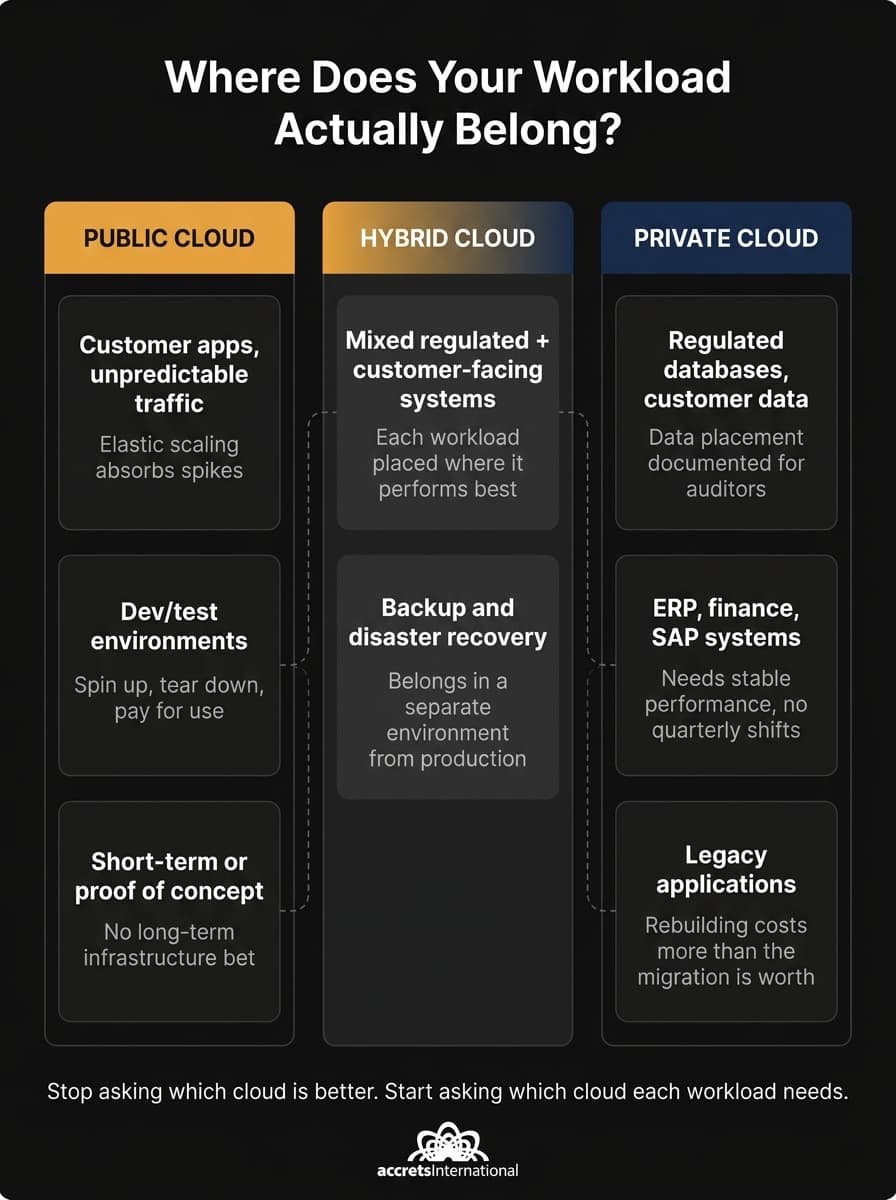
- Customer-facing apps with unpredictable traffic lean public. Elastic scaling absorbs spikes without anyone manually provisioning servers at 2am.
- Dev/test environments lean public for the same reason: spin up, tear down, pay for what you use.
- Regulated databases and customer data platforms lean private or hybrid, where data placement and access can be documented for an auditor without ambiguity. This is where cloud banking and financial services infrastructure in Singapore and Southeast Asia tends to get particular, since regulators care about exactly where data sits and who can touch it.
- ERP, finance, and SAP systems lean private. These need stable performance and a support model that doesn’t change underneath them every quarter, which is part of why SAP infrastructure management is usually its own conversation rather than a footnote in a cloud migration plan.
- Legacy applications with specific dependencies lean private, simply because rebuilding them for a cloud-native stack often costs more than the migration is worth.
- Backup and disaster recovery belong in a separate environment from production, by design. A private cloud system with no tested recovery plan is still fragile no matter how well it’s architected day to day, which is the whole premise behind treating business continuity and disaster recovery as its own workstream rather than an afterthought.
Is private cloud actually more secure?
Not automatically, no. This is the myth that causes the most expensive mistakes.
Public cloud providers pour enormous resources into physical and platform security. Where things go wrong is almost always configuration: an overly permissive IAM policy, a storage bucket left open, monitoring that nobody is actually watching. Private cloud gives you more control over segmentation, access policy, and where data physically lives, which matters when a workload genuinely needs that level of control. But control isn’t security. If patching, log review, and access audits are weak, a private environment can be just as exposed as a poorly configured public one.
The honest comparison isn’t “which cloud is safer.” It’s whether the architecture has proper identity management, network segmentation, monitoring, and incident response, regardless of label. Teams that want a structured way to check this against their own environment usually start with a review like infrastructure security in cloud computing, and for organizations in regulated industries, a cloud security consulting engagement built for Southeast Asia’s regulatory environment tends to surface gaps that don’t show up in a standard checklist.
Is private cloud actually cheaper?
Sometimes. It depends entirely on the shape of the workload.
Public cloud bills creep up from idle resources, premium managed services, and data egress charges that nobody budgeted for. Private cloud costs creep up from overbuilt capacity, underused hardware sitting in a rack, and the staffing it takes to run the thing properly. Neither model has a built-in cost advantage. What decides it is total cost of ownership: compute, storage, licensing, staffing, downtime risk, and migration effort, added up over the workload’s actual lifespan rather than read off a single invoice line.
For workloads with steady, predictable usage and high utilization, private cloud tends to win on TCO once you factor in the operational overhead public cloud quietly adds. The only way to know for sure is to model it properly, which is where a structured IT infrastructure capacity planning exercise earns its keep, comparing the full environment rather than one virtual machine against one subscription tier.
When private cloud is the right call
Private cloud tends to be the better fit when:
- The workload handles sensitive, regulated, or contractually restricted data.
- Demand is steady and predictable rather than bursty.
- The business needs to document exactly where data lives for an auditor.
- Performance has to be consistent, not “usually fine.”
- Legacy dependencies make a cloud-native rebuild impractical.
- The organization wants clear, single-party accountability for what happens when something breaks.
When public cloud is the right call
Public cloud tends to be the better fit when:
- You need to ship something fast and don’t yet know the final demand pattern.
- Traffic is seasonal, bursty, or genuinely unpredictable.
- The workload is short-term, experimental, or a proof of concept.
- You’re building cloud-native around managed services rather than custom infrastructure. If your team is still settling on the basics before committing production systems, it’s worth a pass through the fundamentals of cloud computing first.
Public cloud still needs governance. Without cost controls, tagging discipline, and identity management, a public environment gets expensive and messy fast, just for different reasons than private cloud does.
Where hybrid cloud becomes the practical answer
Most enterprises don’t actually choose one model. They run regulated databases on private infrastructure, customer-facing apps on public cloud, and a separate environment for backup, because that’s what each workload actually calls for. That’s not indecision, it’s workload placement done properly.
The catch is governance. Hybrid only works if networking, access control, monitoring, and cost ownership are mapped clearly across environments, which is why multi-cloud networking and the interoperability between different cloud platforms tend to come up early in any serious hybrid planning conversation, not as an afterthought once things are already running.
Managed private cloud: control without owning every layer
A lot of teams want what private cloud offers without hiring a larger infrastructure team to run it. That’s what managed private cloud solves: a dedicated environment, scoped to your workload and compliance requirements, where a specialist provider handles design, patching, monitoring, and capacity planning while you keep ownership of the outcome.
This is usually the more realistic path for lean IT teams that need private cloud’s control and predictability but don’t have the headcount to operate every layer themselves. Comparing the operating model behind a managed private cloud setup against what your internal team can realistically sustain is a good first step before signing anything. Accrets approaches this architecture-first, scoping the environment around the actual workload rather than fitting every customer into the same template, which is worth understanding before comparing why teams choose Accrets as their managed cloud partner.
How to actually decide
Work from the workload outward, not from a vendor preference inward.
- Classify the data. What does this workload store or transmit, and how sensitive is it?
- Check compliance and residency requirements before any architecture gets designed, not after.
- Estimate how variable demand actually is. Steady usage favors private; bursty usage favors public.
- Compare total cost of ownership, not just the monthly invoice.
- Check latency and integration needs. Some systems need to sit close to users, factories, or other internal systems.
- Be honest about what your team can operate. A private environment nobody has time to maintain becomes a liability, not an asset.
- Pick the model per workload, public, private, hybrid, or managed private, rather than forcing every system into one box.
If migration is part of the picture, it’s worth lining this decision up against a proper cloud migration plan before committing to a timeline.
Not sure which model fits your workload?
A comparison article can only get you so far. The right call depends on your data, your compliance obligations, and what your team can realistically operate, all of which are easier to see in a structured assessment than to guess at from a blog post.
Talk to an infrastructure specialist and get a clear, workload-by-workload view of where private, public, or hybrid cloud actually fits your environment.

Dandy Pradana is an Digital Marketer and tech enthusiast focused on driving digital growth through smart infrastructure and automation. Aligned with Accrets’ mission, he bridges marketing strategy and cloud technology to help businesses scale securely and efficiently.