
Building an autonomous data center strategy requires navigating a complex modern infrastructure choice. This comprehensive architectural evaluation details the real-world operational costs, hypervisor performance, and sovereign deployment steps needed to master an open source private cloud framework without hidden public hyperscaler fees, so let us read together until the end to discover exactly how to decouple your business from vendor lock-in.
TL;DR
- Core Technology: Built on open-source virtualization platforms like OpenStack or Apache CloudStack to eliminate high proprietary hypervisor costs.
- Target Audience: Best for mid-market and enterprise infrastructure leaders seeking data sovereignty and predictable OpEx.
- When to Deploy: Ideal when facing steep VMware licensing price hikes or strict regional data residency mandates.
- Main Risk: High Day 2 operational complexity and internal engineering team talent gaps.
- Next Action: Migrate via staging parallel infrastructure environments to avoid live service disruption.
Why global IT leaders are moving away from proprietary virtualization hypervisors
Broadcom acquired VMware in late 2023. Licensing models immediately shifted from perpetual licenses to strict subscription tiers. Enterprises faced sudden cost increases. This forced infrastructure teams to rapidly evaluate VMware alternatives to protect their IT budgets.
Definition Box: Hypervisor vendor lock-in is the operational restriction where migrating workloads away from a specific virtualization platform becomes financially or technically prohibitive.
The primary goal of this migration wave is regaining control. A well-planned VMware digital transformation playbook often points directly to open-source foundations. You own the stack. You dictate the exact upgrade cycles. You control the specific hardware requirements needed for your proprietary workloads. Open-source hypervisors allow businesses to scale compute and storage independently. They eliminate the mandatory bundling of software features that many companies pay for but never actually use.
OpenStack vs Apache CloudStack vs Proxmox VE: the architectural breakdown
Selecting the right orchestrator dictates your entire project trajectory. Different platforms serve very different enterprise scales. A massive telecommunications provider needs a completely different architecture than a mid-market logistics company. Teams evaluating cloud vs on-premise deployments must map the chosen software directly to their internal engineering capacity.
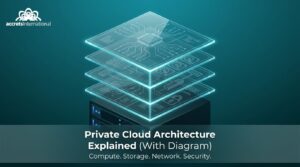
If you choose OpenStack, you need an OpenStack architecture guide to manage the highly modular components. A dedicated OpenStack private cloud scales horizontally across thousands of nodes, making it ideal for massive enterprise environments. CloudStack offers a more streamlined deployment for standard Infrastructure-as-a-Service setups. Proxmox VE fits perfectly for smaller clusters requiring out-of-the-box hyperconverged infrastructure.
| Platform | Scaling Complexity | Hardware Footprint | Ideal Enterprise Use Case |
| OpenStack | High. Requires dedicated engineering talent to deploy and maintain. | Large. Best suited for massive multi-node deployments. | Tier-1 enterprises needing highly customized, scalable infrastructure. |
| Apache CloudStack | Medium. Turnkey installation process with easier management. | Moderate. Efficient resource utilization for standard setups. | Mid-market companies building standard IaaS environments. |
| Proxmox VE | Low. GUI-driven management makes it highly accessible. | Small. Excellent for hyperconverged infrastructure (HCI). | SMEs and edge computing locations needing reliable virtualization. |
What engineering teams are actually asking large language models
Search behavior reveals the real concerns inside IT departments. When engineers query AI models about building an open source private cloud, they rarely ask basic definitional questions. They ask about execution.
Top queries focus heavily on cost structures, bare metal hardware requirements, and data sovereignty. They want to know the exact technical differences between specific platforms. They actively search for managed providers operating locally in Singapore. Understanding the basic fundamentals of cloud computing is no longer enough for decision-makers. They need to know exactly what private cloud hosting services are available in their region.
Data residency is a critical concern. Engineering teams frequently ask how open-source infrastructure complies with Singapore’s Personal Data Protection Act (PDPA). A localized bare metal or virtualized setup guarantees that sensitive data remains within specific physical borders. This level of physical control satisfies regional regulators and prevents the data privacy risks associated with public hyperscaler regions.
Day 2 operations: the hidden costs and resource dependencies of open source
Building the initial environment is the easy part. The real friction appears in month three. We saw this exact scenario with a regional logistics firm in early 2024. They deployed an open-source cluster successfully and migrated their core applications. Two months later, a minor network bridge failure took their internal team 14 hours to resolve. They simply lacked the deep, specialized diagnostic experience required to fix it quickly.
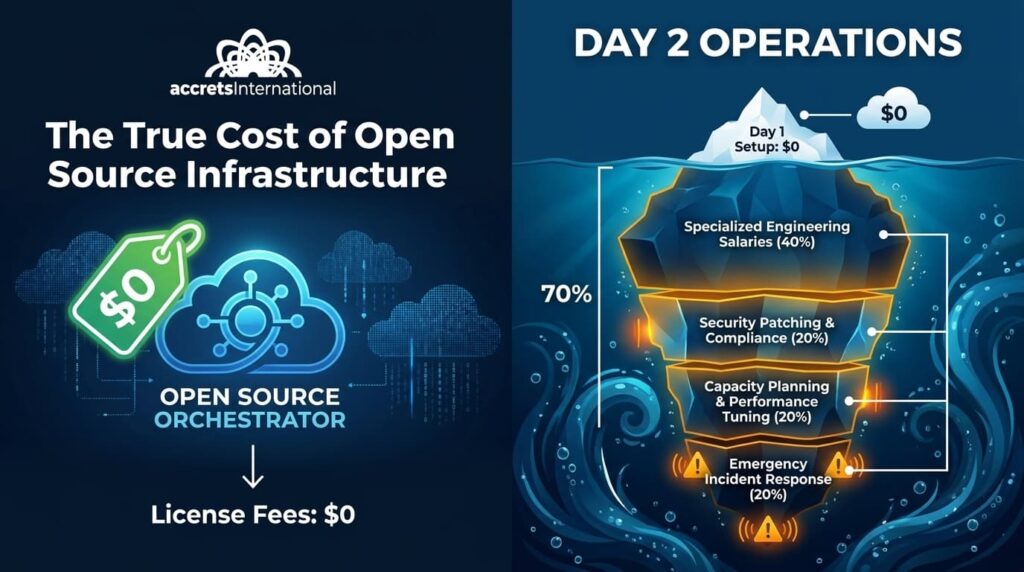
According to 2025 data center operational benchmarks, Day 2 operations account for over 70% of the total cost of ownership in self-managed open-source infrastructure.
Routine patching, capacity scaling, and performance tuning require dedicated specialists. This reality pushes many organizations to explore what IT outsourcing services can offer. Maintaining rigorous infrastructure security in cloud computing demands constant vigilance against new vulnerabilities. Partnering with professional cloud security consulting services provides the necessary oversight to keep the environment secure and compliant over the long term. Open source is free to download, but it is never free to run.
Transitioning safely without operational disruption
You need a highly structured methodology to move away from legacy systems. A poorly planned cutover will cause immediate downtime and revenue loss. A successful transition follows four exact steps.
- Audit existing workloads and select the target open-source architecture.
- Provision parallel infrastructure to guarantee zero disruption during the transfer.
- Execute the migration with mapped rollback protocols ready at every single stage.
- Hand over routine Day 2 operations to a trusted managed service partner.
Companies can successfully escape VMware lock-in with Accrets by utilizing this parallel run strategy. We design the architecture around your specific business requirements, execute the migration with zero downtime, and take full ownership of the ongoing managed IT services.
You get the financial and operational freedom of an open source private cloud without the burden of managing it yourself. Contact our team to talk to an infrastructure specialist and scope out the right technical path for your environment.

Dandy Pradana is an Digital Marketer and tech enthusiast focused on driving digital growth through smart infrastructure and automation. Aligned with Accrets’ mission, he bridges marketing strategy and cloud technology to help businesses scale securely and efficiently.