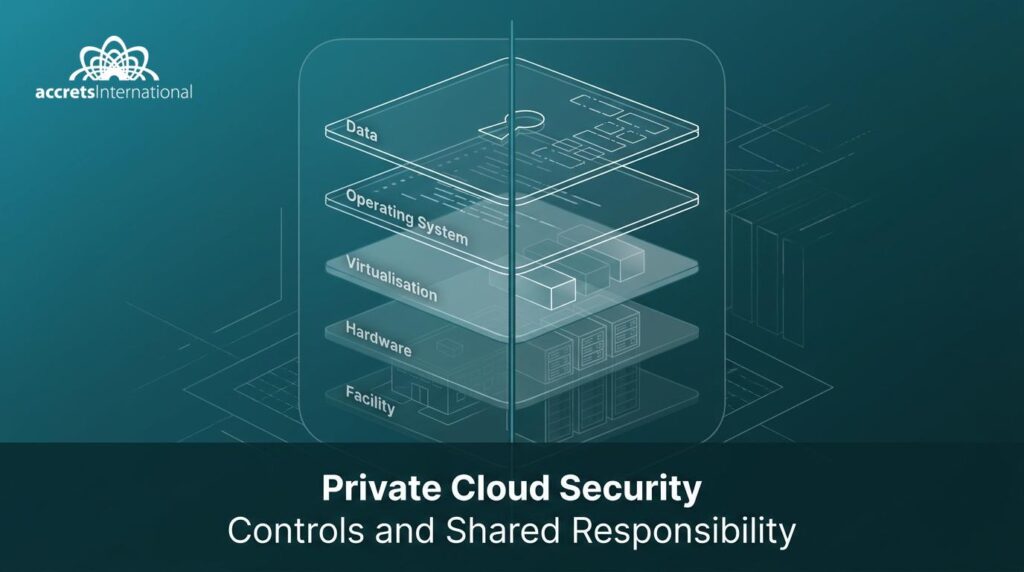

Private cloud security is the set of controls that protect a cloud used by one organisation. A private cloud isolates you from other tenants, but it is not secure by default: your team or your provider must still manage access, patching, encryption, monitoring and recovery. Who does which job depends on whether you build it or buy it managed.
What does private cloud security cover?
Private cloud security covers every layer of a cloud that only your organisation uses, from the facility and hardware to access to the data on it.
Private cloud security is the set of controls, processes and shared duties that protect cloud infrastructure provisioned for exclusive use by one organisation. The wording follows NIST SP 800-145, which says the organisation, a third party or both may own, manage and operate a private cloud, and that it may sit on or off premises.
That definition clears up three common assumptions:
- A private cloud does not have to be on-premises. A provider’s data centre can host one.
- A private cloud is not the same as a virtual private cloud, which runs inside a public cloud provider’s infrastructure.
- Isolation from other tenants is a starting point. It does not patch a server or review an administrator account.
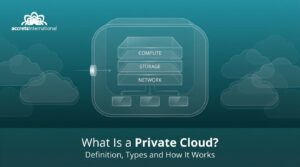
If you need the basics first, we cover what a private cloud is in a separate guide.
Is a private cloud more secure than a public cloud?
A private cloud can give you more oversight and fewer shared tenants, but how secure it is depends on how it is built and run, not on the label.
NIST, writing about public cloud in SP 800-144, says an internal private cloud can potentially give an organisation greater oversight and authority over security and privacy. The word “potentially” is NIST’s own hedge. AWS makes the same point from the other side: some organisations believe a private cloud is more secure, but the benefit is limited by how it is implemented.
| What changes | Private cloud | Public cloud |
|---|---|---|
| Who can share the platform | One organisation, possibly several business units (NIST SP 800-145) | Open to the general public (NIST SP 800-145) |
| Oversight of security | Can potentially be greater (NIST SP 800-144) | Depends on the provider and your contract |
| Who maintains and secures the platform | If you own it, you buy, maintain and secure it (AWS) | Shared between you and the provider (CSA Singapore) |
Neither model is safe by default. A well-run public cloud can beat a neglected private one, and the reverse is also true. Our private cloud vs public cloud guide covers the wider comparison.
Who secures what: shared responsibility in a private cloud
In a private cloud, responsibility depends on who operates each layer: you own all of it when you build it yourself, and you share it when a provider runs the platform.
Shared responsibility is the split of security duties between the cloud user and whoever operates each layer. The Cyber Security Agency of Singapore (CSA) describes the contrast this way: on-premise, the organisation is solely responsible for its cybersecurity, while in a cloud deployment responsibility is shared, and organisations may not be fully aware of the areas they own. CSA’s Cloud Security for Organisations page, last updated 15 April 2025, hosts companion guides that set out a Shared Responsibility Model.
A typical split for a private cloud looks like this under three operating models.
| Layer | Self-built, on-premises | Colocation | Managed private cloud (our service, as one example) |
|---|---|---|---|
| Facility and physical access | You | Facility operator (power, cooling, physical security) | Managed by us |
| Hardware | You | You | Managed by us |
| Virtualisation platform and cloud software | You | You | Managed by us |
| Platform monitoring and security | You | You | Managed by us |
| Guest operating system | You | You | You, or managed by us as an add-on |
| Backup | You | You | You, or managed by us as an add-on |
| Applications and virtual machines | You | You | You |
| Data and who may access it | You | You | You |
| Compliance accountability | You | You | You |
The colocation column is a typical split, so check your contract. In colocation, the operator’s job usually stops at power and physical access, and everything above the rack is yours. The managed column describes our own service and is one example, not the market norm. NIST SP 800-144 adds the point that matters most in the last two rows: an organisation stays accountable for the security and privacy of data that a provider holds for it.
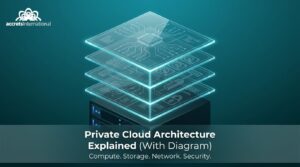
To see the layers themselves, read our private cloud architecture diagram.
If you are still choosing between hosting models, the colocation, private cloud or public cloud decision framework covers that choice.
Core controls for a private cloud
A private cloud needs the same seven controls whoever runs it: identity and access, network segmentation, data protection, patching, logging and monitoring, backup and recovery, and physical security.
Identity and access
Identity and access controls decide who can reach which systems, and with what rights. Least privilege, separate administrator accounts and multi-factor authentication limit the damage from one stolen password. Without them, one compromised account can reach everything. Your team usually owns access to its own virtual machines and applications, whoever runs the platform.
Network segmentation and zero trust
Network segmentation splits the environment into zones so that a problem in one does not spread to the next. Zero trust is an approach in which no asset or user account gets implicit trust based only on its network location or ownership, as defined in NIST SP 800-207. A flat network lets an intruder who gets in anywhere move sideways. Platform networking sits with whoever runs the platform, and your own application traffic sits with you.
Data protection and key management
Data protection covers how data is classified, encrypted and kept under control, and who holds the keys. If it fails, anyone who gets past the other controls can read the data. Ask early who holds the keys and what happens to them when you leave a provider. The data itself is yours in every operating model.
Patching and vulnerability management
Patching closes known flaws in the platform software and the operating systems above it. Unpatched systems stay open to attacks that are already documented. The split follows the table: the platform layer belongs to whoever operates it, and the guest operating system belongs to you unless the provider takes it on as a service.
Logging and monitoring
Logging records what happens in the environment, and monitoring turns those records into alerts someone acts on. A breach that raises no alert can run for a long time. Agree who watches the platform, who watches your applications and how each side learns about an incident.
Backup and recovery
Backup and recovery decide whether you can restore data and services after a failure or an attack. A backup nobody has restored is an assumption, not a control. If a provider runs part of your environment, ask how recovery is tested, because the Monetary Authority of Singapore (MAS) expects financial institutions to verify that for assets managed by service providers. Our IT DR as a Service page describes how we handle recovery for clients who subscribe.
Physical and facility security
Physical security covers who can enter the building, the hall and the rack. Someone with hands on the hardware can bypass every software control. In your own data centre this is yours. In colocation or managed hosting, it sits with the facility operator, so ask what evidence the operator can show.
Frameworks that map these controls
ISO/IEC 27017:2026 gives information security controls for cloud services and, in its own words, applies to all cloud deployment models including the private cloud (IEC webstore). The CSA Cloud Controls Matrix v4.1, released on 27 January 2026, has 207 controls across 17 security domains. NIST SP 800-53 Rev. 5 is a general catalogue of security and privacy controls. A framework is a reference for controls, not proof that a provider holds a certificate.
For multicloud patterns, Kubernetes, infrastructure as code and detection, read our infrastructure security in cloud computing post.
For design choices inside one platform, see our guide to OpenStack private cloud security.
Managed or self-built: what stays on your side
Handing the platform to a managed provider moves the infrastructure work to them, but your data, your user access and your compliance duty stay with you.
What a managed provider takes on, using our service as the example:
- hosting the hardware in the data centre
- running the virtualisation platform
- monitoring and securing the platform
- managing the guest operating system and backup, when you add them as services
What you keep:
- the data on your virtual machines, which you own and keep
- the virtual machines and applications you run
- who in your organisation may access them
- your compliance duty, covered in the next section
We manage the infrastructure layers of our managed private cloud, and the customer owns the data and applications on their virtual machines. Our managed private cloud scope page sets out the split in detail.
Operating system management and backup to enterprise storage are add-ons, and when you add them we manage them too. See managed backup for how that works.
We run our service processes in line with ITIL and ISO practices and host private clouds in several Tier 3 data centres that we use as production and disaster recovery sites. Disaster recovery is a separate subscription. Clients who subscribe get a recovery plan and a rehearsal, typically once a year. What each hosting package includes is listed on our private cloud hosting prices page.
Four questions help decide between running it yourself and handing it over:
- Do you have staff to patch and watch the platform around the clock?
- Who holds the encryption keys?
- What does the contract say about incident notification?
- Can the provider show how recovery is tested?
Managed private cloud
Would you rather hand off the platform work?
If patching, monitoring and recovery sit on your team’s plate today, our team can talk through which layers we would run for you and which stay with you.
Contact UsCompliance for Singapore enterprises: what applies and what you must show
Using a private cloud does not move your legal duty to protect data: the PDPA protection obligation and, for financial institutions, MAS expectations still sit with you.
The PDPA protection obligation is the duty in section 24 of the Personal Data Protection Act 2012 for an organisation to protect personal data in its possession or under its control by making reasonable security arrangements. When a provider processes personal data for you, the Personal Data Protection Commission’s guide to managing data intermediaries says the organisation, as data controller, stays ultimately responsible. Write down who does what, in the contract.
For financial institutions, the MAS Technology Risk Management Guidelines of January 2021 say an institution should assess its exposure to technology risk at a third party before signing, and keep checking that the third party applies a high standard of care. The guidelines apply to MAS-regulated institutions, and how far they apply depends on the risk of the service. MAS also runs a third-party risk management page. It lists the Guidelines on Outsourcing dated 11 December 2023, which took effect on 11 December 2024. The page says MAS is consulting on guidelines on third-party risk management, so those guidelines are not final.
| Reference | Who it applies to | What it asks | What it means for a private cloud |
|---|---|---|---|
| PDPA section 24 | Organisations handling personal data | Reasonable security arrangements | The duty stays with you, hosted or not |
| MAS Technology Risk Management Guidelines, January 2021 | MAS-regulated financial institutions | Manage technology risk at third parties | Verify provider-managed assets, including recovery |
| MAS outsourcing guidelines and third-party risk consultation | Financial institutions | Governance and risk controls over third-party services | Check the current status before you rely on either |
| CSA Cloud Security Companion Guides | Organisations using cloud services | Understand shared responsibility | Use them to map your side of the table |
| CSA Cybersecurity Code of Practice | Owners of critical information infrastructure only | Binding cybersecurity requirements under the Cybersecurity Act | Most readers are out of scope |
| ISO/IEC 27017:2026 and CSA CCM | Reference frameworks | Cloud security controls | Not legal duties; use them to structure evidence |
The CSA codes of practice page, last updated 29 July 2026, confirms that the Code of Practice regulates owners of critical information infrastructure. A standard is a reference for controls. Ask your provider what it holds, and ask for evidence. This section is general information, not legal advice.
A private cloud security checklist
Ask ten questions of your own team or your provider, and treat any answer you cannot evidence as a gap.
- Who patches the platform, and how often?
- Who manages guest operating system patching?
- How is administrator access controlled?
- How are network segments separated?
- How are data and encryption keys protected?
- What is logged, and who reviews it?
- What is backed up, and how are restores tested?
- How is recovery tested for systems a provider runs?
- Where is the data hosted, and who can access it?
- What evidence can the provider show against ISO/IEC 27017 or the CSA Cloud Controls Matrix?
Private cloud security comes down to knowing who owns each layer and being able to show it. If you are weighing who should run yours, we are happy to talk it through.
Private cloud security
Not sure who should run security for your private cloud?
Tell us about your workloads and your compliance duties, and an infrastructure specialist will walk through the split with you.
Get In Touch
Dandy Pradana is an Digital Marketer and tech enthusiast focused on driving digital growth through smart infrastructure and automation. Aligned with Accrets’ mission, he bridges marketing strategy and cloud technology to help businesses scale securely and efficiently.