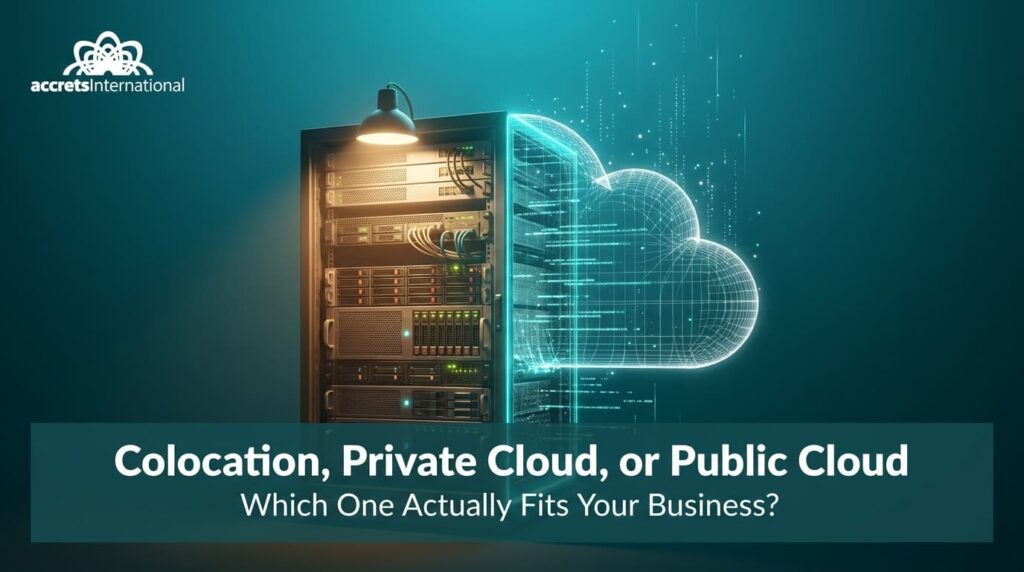

Colocation vs cloud isn’t really a two-option question. Colocation means renting rack space for hardware you own. Public cloud means renting compute from a hyperscaler. Managed private cloud sits between them, a dedicated environment someone else builds and runs for you. Which one fits depends on how predictable your workload is and how much control you actually need over the stack.
TL;DR
- Colocation vs cloud is really a three-way decision: colocation, managed private cloud, and public cloud each fit a different situation, not two competing options.
- Colocation means you own the hardware and rent the space; public cloud means you rent everything; managed private cloud is a dedicated environment someone else runs for you.
- According to Flexera’s 2026 State of the Cloud Report, businesses waste an average of 29% of their cloud spend, which is the real argument for cost predictability in colocation and private cloud.
- Data sovereignty and compliance requirements (MAS TRM, PCI-DSS, and similar frameworks) often decide the answer before cost does.
- Hybrid setups work well when workloads split cleanly between stable, predictable systems and variable, bursty demand.
What is colocation?
Colocation is the practice of housing servers and network equipment you own inside a third-party data center, paying for power, cooling, physical security, and connectivity while keeping full control over the hardware itself. You choose the specs, install and patch the software, and handle everything above the rack. The data center operator’s job stops at power and physical access.
Most colocation contracts in Southeast Asia run on Tier III or Tier IV facilities, the redundancy classifications set by the Uptime Institute that determine how many concurrent equipment failures a site can absorb without going down. Tier III and Tier IV data centers across Southeast Asia differ mainly in how many power and cooling paths run in parallel, and that difference shows up directly in your uptime SLA.
What is cloud computing?
Public cloud is compute, storage, and networking rented from a provider like AWS, Azure, or Google Cloud, billed by consumption instead of ownership. You never touch physical hardware. Provisioning a server takes minutes, not a purchase order and a shipping wait, and the provider handles everything from the data center floor up to the hypervisor.
That convenience runs on an infrastructure-as-a-service model, where compute and storage get abstracted into an API call. The tradeoff is that you’re renting someone else’s provisioning decisions along with the hardware: the region, the availability zone, the underlying chipset generation.
What is managed private cloud?
Managed private cloud is a dedicated environment, not shared with other tenants, that a provider designs, deploys, and operates on your behalf, typically inside a carrier-neutral facility. You get the control of owning your own infrastructure without staffing the team that keeps it patched, monitored, and running at 3am.
It exists because the first two options both leave a gap. Colocation gives you full control, but you still own every operational headache. Public cloud removes the operational burden, but you lose predictability and, in regulated industries, sometimes visibility into where your data physically sits. Why more businesses are choosing private cloud hosting comes down to wanting the control of the first option with the operational relief of the second.
Colocation vs private cloud vs public cloud: side-by-side
Here’s how the three stack up across the variables that actually change a decision.
| Factor | Colocation | Managed private cloud | Public cloud |
| Cost model | Upfront hardware + recurring space/power fees | Predictable monthly OpEx | Pay-as-you-go, scales with usage |
| Who manages the hardware | You | Provider | Provider |
| Control over configuration | Full | High, customized to your workload | Limited to what the provider exposes |
| Scaling speed | Slow, requires physical procurement | Moderate, provider provisions on request | Fast, self-service and available in minutes |
| Compliance / data residency | You control location entirely | Provider commits to a named jurisdiction | Depends on the provider’s regional footprint |
| Best for | Predictable, long-running workloads with in-house IT capacity | Predictable workloads needing compliance without an ops team | Variable or bursty workloads, rapid experimentation |
A quick note on data sovereignty and compliance
Data sovereignty gets treated as a footnote in most comparisons, and it shouldn’t be. Public cloud regions can shift workloads between availability zones or route traffic through infrastructure you didn’t specifically select, usually within terms of service you already agreed to. Colocation and managed private cloud both let you pin data to a specific physical facility, which matters if you’re subject to MAS TRM, PCI-DSS, or similar frameworks that specify where regulated data can live. A Singapore-first playbook for multicloud security covers what that actually requires beyond picking a region from a dropdown.
If you’re weighing this against your own compliance requirements, comparing colocation, private cloud, and hybrid options with our team usually clarifies which column applies to your workload faster than another article can.
What colocation and cloud actually cost
According to Flexera’s 2026 State of the Cloud Report, organizations waste an estimated 29% of their cloud spend. That’s the first increase in five years, driven largely by AI and new IaaS/PaaS services stacking on top of existing bills. That’s the real argument for colocation and private cloud in cost conversations: not that cloud is expensive, but that its cost is hard to predict until the bill arrives.
Colocation and managed private cloud both trade that unpredictability for a fixed or near-fixed monthly number, in exchange for less elasticity when demand spikes. The other side of the ledger is downtime cost. According to Uptime Institute’s 2025 Annual Outage Analysis, more than 54% of significant outages cost over $100,000, and 1 in 5 exceeded $1 million. That number applies regardless of which infrastructure model you’re running, and it’s worth weighing against whatever you’re saving on paper.
Before running your own numbers, a cloud migration plan template is a reasonable starting point for laying out current spend against what each model would cost over 12 and 36 months.
When hybrid beats choosing just one
Hybrid isn’t a compromise position. For a specific kind of workload mix, it’s the correct answer. The pattern that works: stable, latency-sensitive, or compliance-bound systems stay in colocation or private cloud, while workloads with unpredictable demand, like marketing campaigns, seasonal traffic, or batch processing, run in public cloud where elasticity is the whole point.
The friction shows up in the connection between the two, not the decision itself. Getting private and public environments to talk to each other securely, with consistent identity and network policy, is usually where hybrid projects stall. Hybrid cloud providers built for teams managing infrastructure remotely walks through what that connective layer needs to look like to hold up under audit.
Working out which systems actually need to move, and which are fine staying put, is exactly the kind of question an infrastructure specialist can answer faster than a generic checklist.
How to choose: a quick decision framework
Three questions cut through most of the deliberation:
- How predictable is the workload? Steady, forecastable usage favors colocation or private cloud. Spiky or unknown usage favors public cloud.
- How much operational capacity does your team have? A lean IT team of two to five people is usually better served letting a provider run the infrastructure than adding 24/7 monitoring to their plate.
- What does compliance actually require? If a regulator specifies where data must physically reside, that constraint often decides the answer before cost does.
None of these has a universally right answer, which is exactly why “cloud is always cheaper” and “colocation is always safer” are both wrong as blanket statements. Managed vs. cloud services, and which one you actually need goes deeper on the operational-capacity question specifically, since that’s usually the one teams underestimate.
Talk to someone before you decide
None of this is a decision to make from a comparison article alone. Colocation vs cloud arguments online rarely account for your specific compliance requirements or team size.
Talk to an infrastructure specialist about your actual workload, and you’ll get a straight answer on whether colocation, managed private cloud, public cloud, or some mix of the three fits, including why enterprise IT leaders choose Accrets as their managed cloud partner when the answer turns out to be private cloud, and what an on-premise private cloud deployment actually involves if that’s the direction that makes sense.

Dandy Pradana is an Digital Marketer and tech enthusiast focused on driving digital growth through smart infrastructure and automation. Aligned with Accrets’ mission, he bridges marketing strategy and cloud technology to help businesses scale securely and efficiently.