
A private cloud is cloud computing infrastructure provisioned for exclusive use by a single organisation. It gives that organisation self-service, pooled resources and elastic capacity, as a public cloud does, but the organisation, a third party or both can own and run it, and it can sit on or off premises. This follows the NIST definition of cloud computing.
What is a private cloud?
A private cloud is a cloud that one organisation uses exclusively, even when a provider builds or runs it.
A private cloud is a cloud infrastructure provisioned for exclusive use by a single organisation made up of multiple consumers, such as business units. NIST SP 800-145, published in September 2011, adds that the organisation, a third party or a combination of them may own, manage and operate it, and that it may exist on or off premises.
AWS puts the same idea in plainer words: an environment reserved for one organisation, with resources that the organisation alone isolates and controls. Three points about the word “private” are easy to get wrong.
- A private cloud does not have to be on-premises. NIST allows it to sit off premises, so a third party’s facility can host one.
- It is not for a single user. “Exclusive use” applies to the organisation, and many teams and business units inside it can draw on the same pool.
- It is not the same as a virtual private cloud, which runs inside a public cloud provider’s infrastructure. The types section below covers the difference.
The words also turn up in product names such as SAP’s private cloud edition and Apple’s Private Cloud Compute, which are separate products. This guide is about the cloud computing deployment model.
How does a private cloud work?
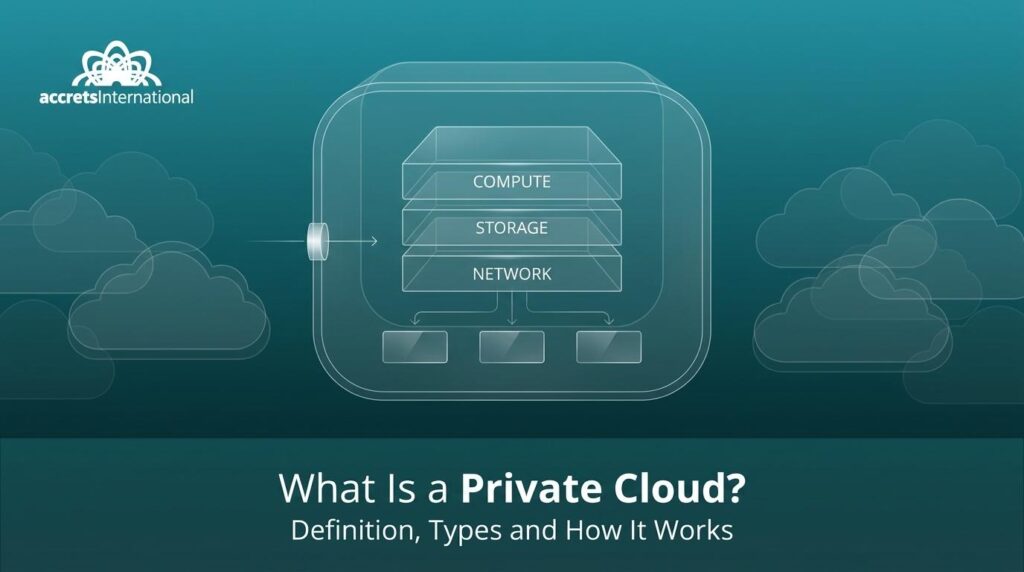
Hardware is virtualised and pooled, central software manages it, and automation hands out capacity on request. A private cloud does the same for one organisation only.
AWS names three working parts. Virtualisation separates IT resources from the physical hardware, so teams can run virtual machines much like physical ones. Management software lets administrators oversee the infrastructure centrally and allocate resources. Automation speeds up repetitive tasks such as provisioning servers.
The NIST definition lists five essential characteristics of any cloud. A private cloud shows each of them inside one organisation:
- On-demand self-service: a consumer provisions capacity such as server time and network storage as needed, without waiting for a person at the provider.
- Broad network access: capabilities are available over the network and reachable from laptops, tablets and mobile phones.
- Resource pooling: computing resources are pooled and assigned to consumers according to demand. In a private cloud, those consumers are the organisation’s own business units and teams.
- Rapid elasticity: capacity can be provisioned and released, sometimes automatically, to scale out and in with demand.
- Measured service: the cloud meters resource use at some level, such as storage, processing or bandwidth, so use can be monitored, controlled and reported.
For the layers and components behind these characteristics, see our private cloud architecture diagram.
Types of private cloud
Private clouds are usually grouped by who runs the hardware and where it sits: on-premises, hosted and managed, with virtual private cloud listed alongside by some vendors.
There is no single standard list. AWS names three types and treats managed and hosted as one. IBM names four: on-premises, virtual private, hosted and managed.
| Type | Where it runs | Who operates it | What the vendors say |
|---|---|---|---|
| On-premises | The organisation’s own data centre | The organisation | AWS and IBM both note significant upfront and ongoing spending |
| Hosted | Off site, on dedicated bare-metal servers (IBM) | The provider owns and controls the assets (IBM) | IBM lists it separately from managed; AWS counts the two together |
| Managed | Usually the provider’s data centre; IBM adds that it can also be hardware on the customer’s site | A third party runs the infrastructure | AWS calls it convenient but still expensive; IBM says it costs more than public cloud or a virtual private cloud |
| Virtual private cloud | Inside a public cloud provider’s infrastructure | The public cloud provider manages the underlying infrastructure (AWS) | IBM describes a logically isolated space on shared infrastructure, usually cheaper and simpler to run than an on-premises build |
A virtual private cloud (VPC) is a private, logically isolated environment inside a public cloud provider’s infrastructure. We treat it as a neighbour of private cloud, not the same thing, because the infrastructure underneath is still shared.
How a hosted private cloud works, and what to check when you pick a provider, is covered in our guide to private cloud hosting.
Private cloud, public cloud and hybrid cloud compared
The three models differ in who may use the infrastructure and where it sits.
A private cloud serves one organisation, as described above.
NIST defines a public cloud as infrastructure provisioned for open use by the general public. A business, an academic body or a government organisation, or a mix of them, can own and operate it, and it sits on the provider’s premises.
A hybrid cloud, in NIST’s words, is a composition of two or more distinct cloud infrastructures (private, community or public) that stay separate but are bound together by technology that allows data and application portability.
IBM sums up the trade-off as more control and customisation in a private cloud, against more elasticity and a lower cost of entry in a public one. Our private cloud vs public cloud comparison shows how to decide between them.
Benefits and trade-offs of a private cloud
The price of control is a higher cost of entry.
- Control: you choose your own hardware and software instead of working from the provider’s catalogue.
- Customisation: you configure servers to your preferences and adapt software through add-ons or custom development.
- Visibility: IBM notes that workloads running behind your own firewall let you see security and access controls directly.
- Regulatory fit: you can shape the environment to your own obligations instead of relying only on a provider’s compliance measures.
Security claims need more care. AWS notes that some organisations believe a private cloud is more secure, and that the benefit depends on how the cloud is implemented.
IBM names two drawbacks:
- Cost: buying, installing and managing hardware and software can be expensive and may call for more IT staff.
- Limited flexibility: extra capacity or new capabilities mean further purchases. IBM says a virtual private cloud or a managed service can ease this.
When a private cloud fits, and when it does not
Fit comes down to two questions: do you need infrastructure that only your organisation uses, and can you run it or pay someone to?
It fits when:
- the organisation needs exclusive use of the infrastructure
- you want to choose or control the hardware, software and configuration
- you have in-house skills to run the platform, or a provider to run it for you
It fits less well when:
- demand is hard to predict and you want elastic capacity at a low cost of entry
- you cannot absorb the upfront hardware spend or extra IT staff, and no provider would carry them
- your workloads run well on shared public cloud services and gain little from exclusivity
We design, build and run managed private clouds, including OpenStack-based environments, in carrier-neutral data centres. We start from the architecture rather than a package and stay vendor-agnostic, so the platform follows your requirements. If OpenStack is on your shortlist, our OpenStack private cloud guide covers fit and architecture.
Where to go next
- Comparing models? Read private cloud vs public cloud.
- Want to see the layers? Open the private cloud architecture diagram.
- Choosing platform software? Compare private cloud software and platforms.
- Weighing hosting models and providers? Start with private cloud hosting.
- Planning an OpenStack build? Follow how to build a private cloud with OpenStack.
Private cloud
Weighing a private cloud for your own workloads?
If the questions above sound like your shortlist, our team can talk through which model fits your requirements, from a managed private cloud to a different route.
Contact Us
Dandy Pradana is an Digital Marketer and tech enthusiast focused on driving digital growth through smart infrastructure and automation. Aligned with Accrets’ mission, he bridges marketing strategy and cloud technology to help businesses scale securely and efficiently.