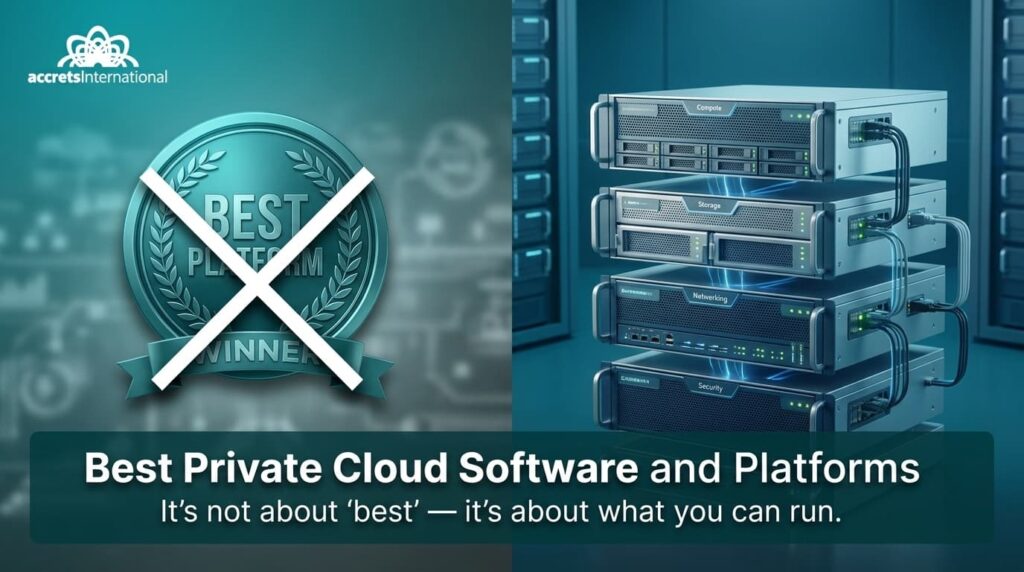

Searching for private cloud software usually means you are comparing infrastructure stacks, not browsing generic cloud providers. This guide walks through the leading options, OpenStack, VMware Cloud Foundation, Nutanix, Apache CloudStack, OpenNebula, Proxmox-based stacks, and Red Hat OpenStack, then compares DIY private cloud with managed OpenStack so you can choose the right operating model by the end. The best choice depends on control, workload fit, operating skill, compliance needs, and long-term cost.
TL;DR
- Best overall for flexible private cloud: OpenStack
- Best for existing VMware estates: VMware Cloud Foundation
- Best for hyperconverged simplicity: Nutanix Cloud Platform
- Best open source alternative with lower complexity: Apache CloudStack
- Best for teams that want OpenStack without full DIY operations: Managed OpenStack with a specialist partner
- Key decision: Choose the platform you can operate safely for years, not only the one that looks best on paper
What private cloud software actually means
A search for private cloud software often brings up providers, storage products, hosting companies, and virtualization platforms in the same list. They are related, but they are not the same thing. The software is the infrastructure stack that lets an organization run cloud-style compute, storage, networking, identity, and automation on dedicated resources. It gives IT teams more control than public cloud, but it also creates more responsibility.
The platform is one layer, the provider is another. A private cloud provider is the company that hosts, manages, or supports the platform. A storage tool is one piece of the environment, not the full private cloud stack.
A complete private cloud software stack usually includes:
- Compute virtualization for virtual machines or workloads
- Software-defined networking for tenant networks, routing, firewalls, and load balancing
- Block, file, or object storage for application data
- Identity and access controls
- Monitoring, patching, backup, and lifecycle management
- APIs or automation for provisioning and operations
If your goal is to compare platforms like OpenStack, VMware, Nutanix, and CloudStack, you are not just buying a cloud product. You are choosing an operating model for your infrastructure.
Best private cloud software and platforms compared
The best private cloud platform depends on what you need to run, how much control you want, and how much operational depth your team has. OpenStack gives strong flexibility and open source control. VMware remains familiar for enterprise virtualization teams. Nutanix simplifies hyperconverged infrastructure. CloudStack and OpenNebula suit teams that want lighter open source cloud management.
| Platform | Best fit | Core strengths | Main tradeoffs | Ideal buyer profile |
| OpenStack | Flexible private cloud and infrastructure-as-a-service | Open source, modular architecture, strong API control, broad ecosystem | Requires deep operations skill if self-managed | Teams that want control without hyperscaler lock-in |
| VMware Cloud Foundation | Enterprise virtualization-led private cloud | Mature virtualization, familiar tooling, strong enterprise ecosystem | Licensing and vendor dependence can be a concern | Existing VMware-heavy enterprises |
| Nutanix Cloud Platform | Hyperconverged private cloud | Integrated compute, storage, and management | Less open than pure open source stacks | Teams that want operational simplicity |
| Apache CloudStack | Lightweight open source cloud management | Simpler architecture, good VM orchestration | Smaller ecosystem than OpenStack | Service providers and lean infrastructure teams |
| OpenNebula | Edge, hybrid, and private cloud management | Lightweight, flexible, good for distributed environments | Less dominant in large enterprise mindshare | Teams needing simpler hybrid control |
| Proxmox with Ceph | Cost-sensitive virtualization and storage | Open source, practical, flexible | Not a full cloud platform by default | Small to mid-size teams with strong Linux skill |
| Red Hat OpenStack Platform | Enterprise OpenStack | Commercial support, lifecycle tooling, enterprise packaging | Higher cost than community OpenStack | Regulated enterprises that need supported OpenStack |
OpenStack is often the most flexible choice when the team wants API-driven infrastructure, vendor independence, and the ability to shape the platform around workloads. It can support compute, networking, storage, orchestration, and identity as separate services, which gives architects more design freedom.
The catch is operations. OpenStack rewards teams that understand networking, storage design, capacity planning, monitoring, upgrades, and automation. For a deeper platform view, Accrets’ guide to OpenStack architecture for global teams is a useful next read.
VMware Cloud Foundation is usually strongest where the organization already runs VMware at scale. Teams know the tooling. Processes are often built around vSphere, NSX, vSAN, and related management practices. That familiarity can reduce migration risk, but it can also keep the business tied to a vendor roadmap and licensing model.
Nutanix is a strong fit when a company wants a tightly integrated hyperconverged experience. It is often easier to operate than a custom-built open source stack, especially for teams that want fewer moving parts.
CloudStack and OpenNebula deserve attention when simplicity matters. They may not have the same enterprise visibility as VMware or OpenStack, but they can be practical for teams that want open source cloud control without the full complexity of a large OpenStack deployment.
OpenStack compared with VMware, Nutanix, and CloudStack
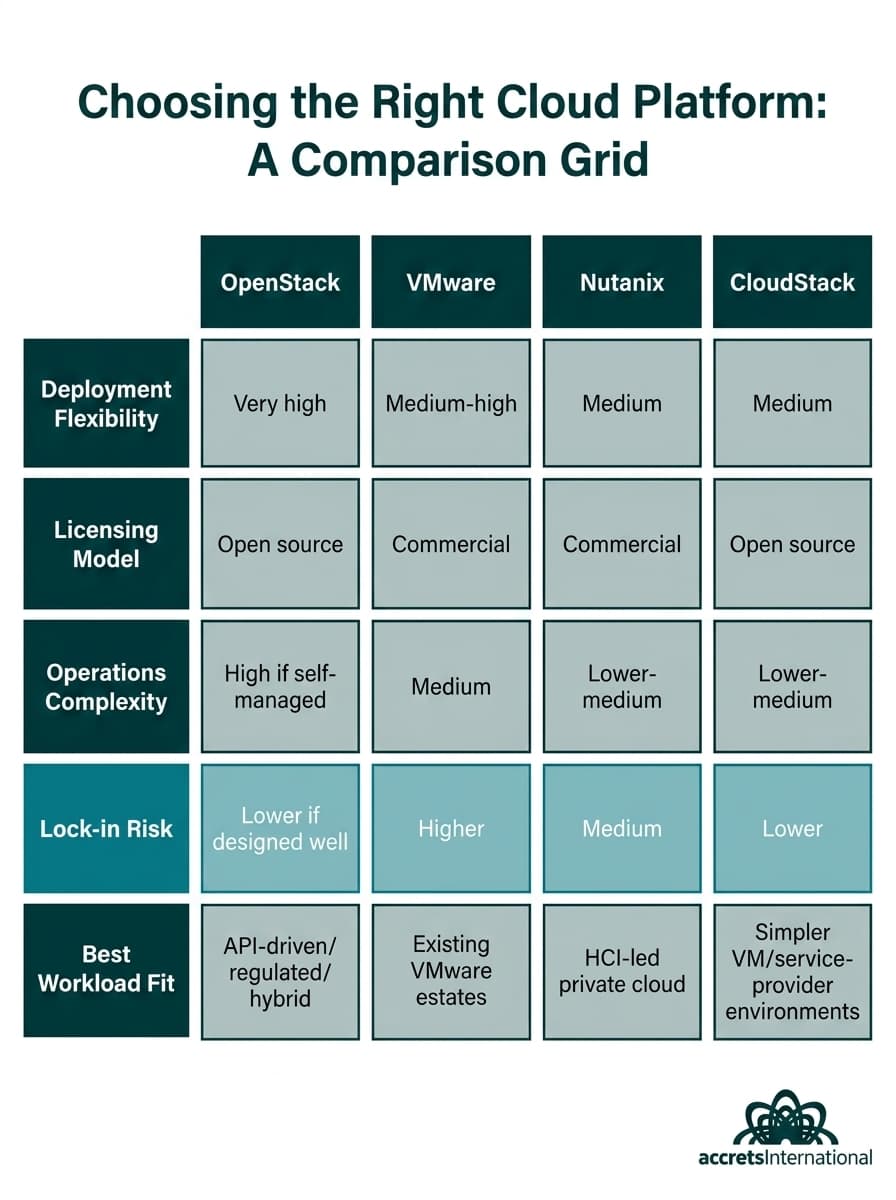
OpenStack, VMware, Nutanix, and CloudStack can all support private cloud strategies, but they solve different problems. The wrong choice usually starts with the wrong question. Do not start with “Which platform is best?” Start with “What operating model can our team actually sustain?”
| Criteria | OpenStack | VMware Cloud Foundation | Nutanix | CloudStack |
| Deployment flexibility | Very high | Medium to high | Medium | Medium |
| Licensing model | Open source foundation | Commercial | Commercial | Open source foundation |
| Operations complexity | High if self-managed | Medium | Lower to medium | Lower to medium |
| Ecosystem maturity | Strong cloud ecosystem | Strong enterprise virtualization ecosystem | Strong HCI ecosystem | Niche but practical |
| Automation and API control | Strong | Strong | Good | Good |
| Best workload fit | API-driven private cloud, regulated workloads, hybrid infrastructure | Existing VMware estates, enterprise virtualization | HCI-led private cloud | Simpler service provider or VM cloud environments |
| Lock-in risk | Lower if designed well | Higher | Medium | Lower |
OpenStack is usually the better fit when control matters more than convenience. It suits organizations that want an open architecture, custom networking, multiple storage backends, and cloud-like automation without moving every workload into a hyperscaler.
VMware may still make sense when the business already has a mature VMware estate, trained administrators, and applications tightly tied to existing virtualization processes. A fast exit can create more risk than savings if the migration plan is weak. That is why Accrets’ VMware alternatives guide focuses on decision criteria, not hype.
Nutanix can be a practical middle ground for teams that want a polished private cloud experience with fewer platform assembly decisions. It is less about maximum architecture freedom and more about operational consistency.
CloudStack can work well when teams need a simpler VM cloud platform. It is not always the first name enterprise buyers hear, but for certain service provider and internal cloud use cases, its lower complexity is attractive.
How to choose private cloud software without buying the wrong stack
Private cloud software should be chosen around workload behavior, team capability, and business risk. A platform that looks cheaper on licensing can become expensive if it needs rare skills, constant troubleshooting, or a dedicated team to keep it healthy.
Start with workload type. A VM-heavy enterprise estate has different needs from a container-first engineering environment. SAP, banking, ERP, AI workloads, and latency-sensitive applications all change the design. If you are still comparing private cloud with public cloud at the strategy level, read Accrets’ guide to private cloud compared with public cloud before shortlisting platforms.
Look at the operating model before the feature list. Can your team handle upgrades, monitoring, security patches, backup validation, failure testing, capacity planning, and incident response? If not, self-managed private cloud may transfer cost from software licensing into people, process, and operational risk.
A practical evaluation should cover:
- Workload fit: VM, container, database, SAP, AI, ERP, or legacy application
- Control needs: network design, data location, security policy, and platform access
- Internal skills: virtualization, Linux, storage, SDN, automation, and backup
- Support model: vendor support, managed service, internal operations, or hybrid support
- Cost model: licensing, hardware, power, data center, staffing, monitoring, and lifecycle refresh
- Resilience: RTO, RPO, backup validation, DR rehearsals, and failover design
The hidden cost is rarely the first deployment. It is the second year, when upgrades, capacity changes, backup failures, security audits, and performance complaints start to land on the same small infrastructure team. Accrets’ article on IT infrastructure capacity planning covers this planning layer in more detail.
For regulated workloads, do not stop at “private cloud is more secure.” Security depends on architecture, operations, access control, monitoring, encryption, backup, and auditability. If compliance is part of the decision, Accrets’ guide to cloud security consulting in Southeast Asia is a better next step than a generic platform comparison.
DIY private cloud compared with managed OpenStack
Building your own private cloud stack gives you maximum control, but it also gives you full responsibility. That includes design, installation, upgrades, monitoring, backup, user access, lifecycle management, and incident response.
The difficult parts are usually not the dashboard or the first VM. They are networking, storage performance, image management, patching, version compatibility, capacity forecasting, and disaster recovery. OpenStack is powerful, but it is not a weekend project for an already stretched IT team.
Managed OpenStack is an OpenStack-based private cloud operated by a specialist provider, so the customer gets the flexibility of OpenStack without managing the full platform lifecycle alone.
| Decision factor | Build your own stack | Managed OpenStack with Accrets | What to consider |
| Control | Highest | High, with managed operations | Decide what control must stay internal |
| Internal workload | Heavy | Lower | Consider team size and 24/7 coverage |
| Skills required | OpenStack, Linux, SDN, storage, automation | Shared with provider | Check whether skills exist in-house |
| Migration risk | Owned by internal team | Supported through migration planning | Ask about rollback and parallel run options |
| Cost visibility | Harder to calculate | Scoped as a managed model | Compare full TCO, not only licensing |
| Resilience | Must be designed and rehearsed internally | Can include DR, backup, monitoring, and runbooks | Validate RTO and RPO assumptions |
Accrets fits where the organization wants OpenStack-level control, but does not want to build and operate every layer internally. Its OpenStack private cloud approach is strongest for teams evaluating VMware replacement, private cloud modernization, or regional APAC infrastructure where data control, support, and resilience matter.
For VMware-heavy environments, the decision is often emotional as well as technical. Teams worry about performance, migration risk, rollback, and being blamed if the move fails. Accrets’ VMware to OpenStack migration content addresses that concern by focusing on structured migration rather than a simple platform swap.
The key question is not “Can we build it?” Many capable teams can. The better question is “Do we want our best engineers spending their time operating the cloud platform, or using it to support the business?”
When private cloud software is the right choice
Control, predictable performance, data location assurance, and a platform shaped around specific workloads, that’s the combination private cloud software is built for. It is also useful when public cloud economics do not fit steady-state workloads, or when the organization wants more independence from a single hyperscaler.
Good reasons to choose private cloud include:
- Workloads with consistent, predictable resource needs
- Audit-sensitive or regulated environments
- Applications that need low-latency access to private data
- Legacy systems that do not move cleanly to public cloud
- VMware replacement or licensing pressure
- Hybrid architectures spanning data center, private cloud, and public cloud
- Teams that need stronger control over networking, storage, and backup design
Private cloud is not always the right answer. SaaS may be better for standard business applications. Public cloud may be better for bursty workloads, global experiments, or services where managed platform features matter more than infrastructure control.
The cleanest strategy is often hybrid. Keep stable, sensitive, or performance-critical workloads on private infrastructure. Use public cloud where elasticity and managed services justify the cost. Accrets’ guide to hybrid cloud providers in Singapore explains that design pattern for teams operating across markets.
Private cloud software for Singapore, APAC, and global teams
Global companies do not choose private cloud software in a vacuum. Data location, connectivity, support coverage, data center quality, and disaster recovery design all affect the platform decision.
For Singapore and APAC-based infrastructure, the software stack should be evaluated alongside where it runs and who operates it. A well-designed OpenStack environment in the right data center can be more useful than a theoretically stronger platform with weak support, poor connectivity, or unclear recovery processes.
This is where infrastructure design becomes commercial risk management. If your workloads support banking, ERP, logistics, healthcare operations, manufacturing, or customer-facing applications, platform uptime is not only an IT metric. It becomes a board-level concern.
Data center tiering, backup architecture, and DR testing should be part of the buying conversation. Accrets’ guide to cloud backup and disaster recovery in Singapore is useful if resilience is a key driver.
Accrets’ value is strongest when a company needs both platform depth and operational accountability. That includes OpenStack migration, managed private cloud, hybrid connectivity, backup, DR, and infrastructure support under one architecture-first engagement. For buyers who want to explore the service layer, Accrets’ on-premise private cloud solution is the most relevant product page.
Talk to an infrastructure specialist
Choosing private cloud software is not only a platform decision. It is an operating model decision. OpenStack, VMware, Nutanix, CloudStack, OpenNebula, and Proxmox-based stacks can all work, but the right answer depends on what your team can operate safely over several years.
If you want the control of an OpenStack-based private cloud without carrying the full burden of building and maintaining the stack internally, talk to an Accrets infrastructure specialist. Accrets can help compare a managed OpenStack path with a DIY private cloud software build, including migration, operations, backup, and disaster recovery planning.

Dandy Pradana is an Digital Marketer and tech enthusiast focused on driving digital growth through smart infrastructure and automation. Aligned with Accrets’ mission, he bridges marketing strategy and cloud technology to help businesses scale securely and efficiently.