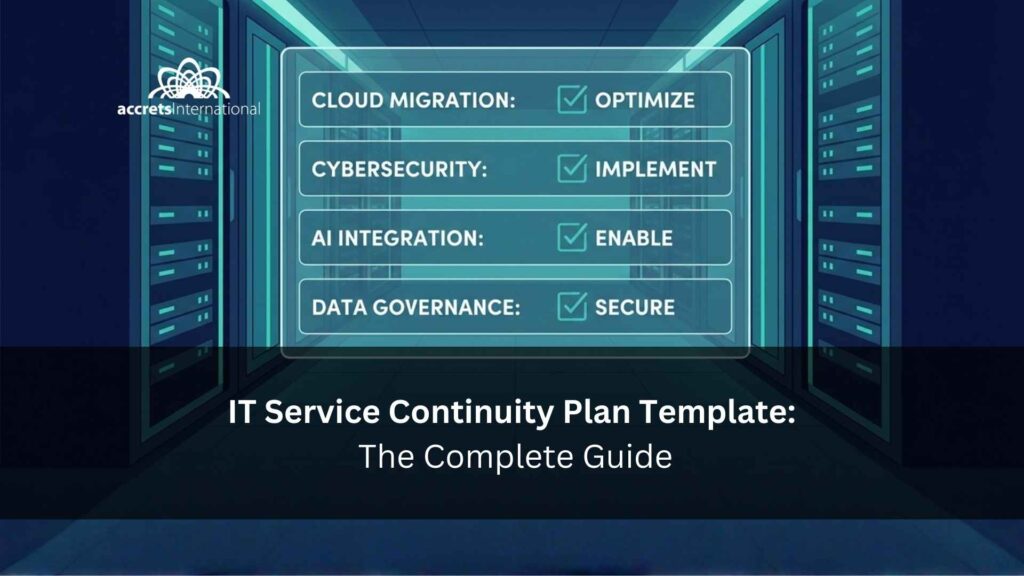

An IT Service Continuity Plan (ITSC Plan) is a documented framework that ensures your critical IT services remain operational or are rapidly restored following any disruption. A complete template covers six core sections: plan overview and scope, business impact analysis, risk register, recovery strategy, roles and responsibilities, and a testing schedule.
This guide walks you through each section with real examples, explains how to choose between ITIL and ISO 22301, and flags the mistakes that cause most ITSC plans to fail when they are needed most. If you are building your first plan or reviewing an existing one, read through to the end and you will leave with a structure you can start filling in today.
TL;DR
- An ITSC Plan keeps IT services running (or recovers them fast) during disruptions. It is not the same as a BCP or DRP.
- A complete template has 6 sections: Plan Overview, BIA Summary, Risk Register, Recovery Procedures, Roles and Communication Plan, and Testing Log.
- ITIL 4 covers operational structure. ISO 22301 covers enterprise compliance. Use both together.
- The most common failure is writing the plan once and never testing it.
- Accrets offers managed IT DR, backup, and cloud infrastructure services to make your ITSC plan executable, not just documented.
When a ransomware attack hit several UK hospital networks in 2016, over 2,800 patients were turned away, including expectant mothers and people waiting for surgery. The systems went dark for five days. The damage was not just financial. It was operational, reputational, and in some cases, life-threatening. The root cause was not a lack of antivirus software. It was the absence of a tested, structured IT Service Continuity Plan.
This guide gives you exactly that: a complete, ITIL-aligned IT Service Continuity Plan template you can start building today. Not just theory, but a real section-by-section framework with examples, common pitfalls to avoid, and clear guidance on what belongs in every field. Whether you are an IT Manager building your first plan or a CIO reviewing an outdated one, this is the resource the rest of the internet has not quite managed to put together in one place.
As a Singapore-based managed IT and cloud infrastructure provider serving businesses across APAC and beyond, Accrets has helped organizations at every stage of their continuity journey, from first drafts to tested, board-approved plans. What follows is a distillation of that experience.
What Is an IT Service Continuity Plan (and Why Most Organizations Get It Wrong)
An IT Service Continuity Plan (ITSC Plan) is the documented strategy and set of operational procedures that ensures your critical IT services can either be maintained through a disruption or restored to an acceptable level of function within a defined timeframe.
That definition sounds simple. The execution is not.
Before you build your plan, it helps to be clear on what an ITSC plan is not. These three terms get conflated constantly, and the confusion leads to dangerous gaps:
| ITSC Plan | Business Continuity Plan (BCP) | Disaster Recovery Plan (DRP) | |
| Scope | IT services specifically | All business functions | Full IT system restoration |
| Speed priority | Maintain minimum viable IT | Keep the business operating | Restore to full operations |
| Owner | IT Manager / ITSM team | COO / Business Continuity Manager | IT Director / DR team |
| Triggered by | IT service disruption | Any business disruption | Full disaster or major incident |
Your IT disaster recovery plan template and your ITSC plan work in parallel, but they serve different purposes. The DRP is about getting everything back. The ITSC plan is about keeping the lights on long enough to do so.
The most common mistake organizations make is writing their ITSC plan once, filing it away, and never testing it. By the time an incident strikes, the plan references systems that no longer exist, contacts who have left, and recovery targets that were never validated against real infrastructure. A plan untested is a plan that will fail.
The ITIL 4 Service Continuity Management practice provides the gold standard framework for building plans that stay current and operational. Pairing it with solid backup and disaster recovery foundations is what turns a compliance document into a real operational asset.
The 6 Core Sections of an Effective IT Service Continuity Plan Template
Here is the framework. Each section maps to a real component of a working ITSC plan. Use this as your starting structure, then customize it to your environment.
1. Plan Overview and Scope
What it is: The administrative backbone of the document. This section tells anyone picking up the plan, at 2am during an incident, exactly what it covers, who owns it, and when it was last validated.
What to include:
- Plan owner name and contact
- Version number and change history
- Review and testing schedule (minimum: annually)
- Scope statement: which IT services are covered, and which are explicitly excluded
- Activation triggers: the specific conditions under which the plan is invoked
Example scope statement: “This plan covers all customer-facing applications hosted on [platform], internal communication systems, and core data management services. It is activated when any covered service experiences unplanned downtime exceeding four hours, or when a P1 incident is declared by the IT Manager.”
Clear activation criteria matter more than most teams realize. Vague triggers lead to delayed decisions at exactly the moment when speed is critical.
2. Business Impact Analysis (BIA) Summary
What it is: The BIA is the evidence base for every prioritization decision in your plan. Without it, you are guessing which systems matter most.
What to include:
- All critical IT systems and the business functions they support
- Maximum Tolerable Downtime (MTD): how long can this system be down before irreversible harm occurs?
- Recovery Time Objective (RTO): the target time to restore the system
- Recovery Point Objective (RPO): how much data loss is acceptable (measured in time)
Example BIA table:
| System | Business Function | RTO | RPO | MTD |
| CRM Platform | Sales operations | 4 hours | 1 hour | 24 hours |
| Email/Collaboration | All departments | 2 hours | 15 minutes | 8 hours |
| Core Banking App | Transactions | 30 minutes | 0 (real-time) | 2 hours |
| Internal HR System | Payroll | 24 hours | 4 hours | 72 hours |
Your cloud infrastructure setup will heavily influence what RTOs and RPOs are realistically achievable, and this is worth validating with your provider before committing these targets to the plan.
3. Risk Register
What it is: A structured log of the threats that could trigger your ITSC plan, assessed by likelihood and impact, along with the mitigation already in place.
What to include:
- Threat categories: ransomware/cyberattack, hardware failure, power outage, natural disaster, third-party vendor failure, accidental data deletion
- Likelihood rating (1 to 5)
- Impact rating (1 to 5)
- Current mitigation controls
- Residual risk rating
This section should be informed by ISO 22301 (Business Continuity Management) and NIST SP 800-34 (Contingency Planning Guide for IT Systems), both of which provide rigorous risk classification frameworks. If you are operating in a regulated sector, strong cloud security consulting can help you align your risk register to regional compliance requirements, including MAS TRM guidelines for financial institutions in Singapore.
4. Recovery Strategy and Procedures
What it is: The operational heart of your ITSC plan. This is the section your recovery team will actually use during an incident.
What to include:
- Recovery strategy per critical system (warm standby, cold standby, cloud failover, geographic redundancy, colocation)
- Step-by-step recovery procedures for each system, specific enough that someone unfamiliar with the system can execute them
- Assigned team member responsible for each step
- External vendor escalation contacts (cloud providers, MSPs, hardware vendors)
Cloud-based recovery has become the standard approach for organizations that need speed without the capital cost of a fully redundant on-premise environment. A managed cloud backup and disaster recovery environment means your recovery steps can be as simple as spinning up a pre-configured instance rather than rebuilding from scratch. For organizations that want this fully managed, IT DR as a Service removes the burden of maintaining the environment in-house while keeping your RTO commitments intact.
5. Roles, Responsibilities, and Communication Plan
What it is: Your incident response chain of command. Everyone needs to know their role before the incident happens, not during it.
What to include:
- ITSC Coordinator: the single point of accountability for plan activation and execution
- Damage Assessment Team: responsible for evaluating scope and severity within the first hour
- Recovery Team Leads: one per critical system or workstream
- Executive communication lead: responsible for board and leadership briefings
- External communication lead: vendors, regulators, and customers if applicable
Example notification flow:
Incident declared, then IT Coordinator notified within 15 minutes, then Damage Assessment Team activated within 30 minutes, then initial impact scope reported to IT Coordinator within one hour, then Recovery Team deployed per BIA priority order, then Executive briefing issued within two hours, then vendor escalations initiated as required.
One detail most plans miss: include personal mobile numbers, not just office lines. Incidents do not wait for business hours.
6. Testing Schedule and Review Log
What it is: The section that separates plans that work from plans that just exist.
What to include:
- Test types and their frequency:
- Tabletop exercise (quarterly): walk through a scenario in discussion only
- Simulation test (bi-annually): run a simulated incident with the actual team
- Parallel test (annually): bring up recovery systems without cutting over
- Full failover test (annually): complete cutover to recovery environment
- Last test date, participants, and findings
- Formal review triggers: major infrastructure changes, staff turnover, post-incident review, annual cycle
Your managed IT services provider should be an active participant in your testing schedule, not a passive observer. If they cannot demonstrate how they will perform during a real invocation, they should not be in your recovery chain.
ITIL vs. ISO 22301: Which Framework Should Your ITSC Plan Follow?
This is the question most IT managers hit when they start building their plan, and most articles dodge it.
The practical answer: you do not have to choose.
ITIL 4 (specifically the Service Continuity Management practice) is designed for IT-specific continuity within an existing ITSM environment. If your organization already uses ITIL for incident management, change management, or service desk operations, ITIL is your natural operational foundation for the ITSC plan.
ISO 22301 is an enterprise-wide Business Continuity Management standard. It is broader, requires formal certification, and is most relevant for organizations that need to demonstrate BCM maturity to regulators, auditors, or enterprise clients.
The most resilient approach is to use ITIL as the operational structure of your ITSC plan, and ISO 22301 as the compliance and audit overlay. They are not competing frameworks but complementary layers.
For organizations operating in Singapore, this is particularly relevant. Singapore’s government digital transformation agenda and the MAS Technology Risk Management (TRM) Guidelines set specific expectations for IT resilience in regulated industries. Building your ITSC plan against ITIL and ISO 22301 gives you a defensible position in any regulatory review, while following IT infrastructure management best practices ensures the operational integrity of the plan itself.
Common ITSC Planning Mistakes (And How to Avoid Them)
After working with businesses across APAC on their continuity and recovery environments, these are the mistakes that appear most often.
1. Setting RTO/RPO targets that your infrastructure cannot actually meet. An RTO of two hours sounds reasonable. But if your recovery environment has not been tested, if your IT infrastructure capacity planning does not account for peak-load recovery scenarios, or if your backups have not been verified recently, that two-hour target is fiction.
2. Treating the ITSC plan as a compliance document, not an operational tool. Plans written for auditors tend to be written at auditors. The people who need to use the plan during an incident are your recovery team. Write for them.
3. Leaving third-party vendors and cloud providers out of the recovery chain. Your ITSC plan is only as strong as the weakest link in your recovery environment. If a critical SaaS platform or cloud provider is not in your risk register, your vendor contacts are not in the communication plan, and their SLAs are not reflected in your RTO assumptions, you have a gap.
4. Skipping the annual test. A plan that has not been tested is a plan that will not work. Use your managed backup services to schedule and document restore tests at least quarterly.
5. Failing to align the ITSC plan with board-level risk appetite. If your plan authorizes spending $50,000 on emergency recovery resources but your risk committee has never discussed this, you will be seeking approval at the worst possible moment. Get sign-off on cost and authority thresholds before you need them.
Building Your ITSC Plan: Where Accrets Can Help
If any of the mistakes above sound familiar, you are not alone, and you do not have to solve it alone either.
Accrets is a Singapore-based managed cloud and IT infrastructure provider with deep APAC experience in business continuity planning, cloud infrastructure, and disaster recovery. We work with mid-size enterprises, financial institutions, and global teams operating in Southeast Asia to build IT environments that are resilient by design, not just on paper.
For organizations building or reviewing their ITSC plan, we offer:
- IT DR as a Service: a fully managed disaster recovery environment that keeps your RTO commitments real and tested
- Managed Backup Services: automated, verified backup aligned to your RPO targets, with restore testing built in
- Cloud Infrastructure as a Service: scalable, resilient cloud foundations that make warm standby and cloud failover strategies practical for organizations of any size
- Cloud computing and backup/DR in Singapore: purpose-built for organizations with APAC operations that need regional compliance and low-latency recovery
As a managed cloud service provider, we do not just help you write the plan. We help you build the infrastructure that makes the plan executable, and we help you test it. Because a plan that works is better than a plan that looks good. You can also explore our full range of disaster recovery solutions tailored for your industry and operational environment.
Get Your Free IT Service Continuity Plan Template
Ready to Build Your IT Service Continuity Plan? Let’s Talk.
A well-built IT Service Continuity Plan is the difference between a disruption that costs your organization hours and one that costs months. The six-section framework above gives you the structure. Your infrastructure, your team, and your risk profile fill in the details.
If you would like an Accrets Cloud Expert to review your current ITSC plan, stress-test your RTO/RPO assumptions against your actual infrastructure, or help you build a plan from scratch, we are here.
Fill in the form for a free consultation with an Accrets Cloud Expert
No obligation. Just a conversation with someone who has done this before.
Accrets is a Singapore-based managed IT and cloud infrastructure provider specializing in business continuity, disaster recovery, cloud infrastructure, and managed services for mid-size enterprises and global teams operating in APAC.

Dandy Pradana is an Digital Marketer and tech enthusiast focused on driving digital growth through smart infrastructure and automation. Aligned with Accrets’ mission, he bridges marketing strategy and cloud technology to help businesses scale securely and efficiently.