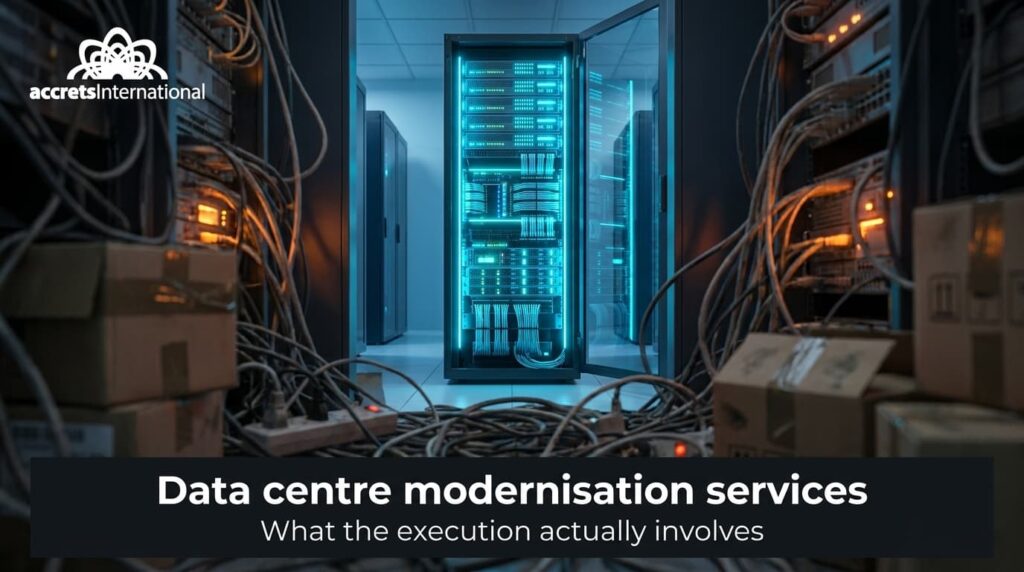

Data centre modernisation services transform legacy IT infrastructure into agile, secure hybrid cloud environments. True modernisation requires thorough workload discovery, network refactoring, and post-migration managed operations rather than simply swapping out physical hardware. Continue reading to explore the exact steps and strategies needed to execute this transition without taking your business offline.
TL;DR
- Go beyond hardware: True modernisation demands an assessment-first methodology focused on software dependencies and operations.
- Understand the drivers: VMware licensing shifts, AI workload demands, and strict compliance rules are forcing IT leaders to act immediately.
- Minimize execution risk: Phased migrations allow critical applications to remain live during the transition to new platforms like OpenStack.
- Choose operators over sellers: Managed service providers offer long-term runtime stability compared to traditional hardware resellers.
Why data centre modernisation projects run over budget and behind schedule
Enterprise server rooms are littered with legacy tech stacks that cost more to keep alive than they deliver in operational value. When corporate leadership requests an infrastructure overhaul, the initiative frequently lands on the desk of a hardware vendor or an IT reseller. This is where the structural friction begins. A box-shipper views modernisation through a single lens: shifting physical equipment inventory. They generate a bill of materials packed with high-margin blades, storage arrays, and proprietary software licenses, treating architecture as an afterthought.
The real failure happens during the execution phase. Because resellers do not stay around to manage day-2 runtime operations, their plans lack real-world migration mechanics. They hand over a pile of hardware and leave the internal IT team to handle the technical debt of application dependencies, code refactoring, and data cutover. Internal teams, already buried under daily troubleshooting tickets, find themselves drowning in unexpected integration complexities. Networks break down, data ingestion halts, and timelines stretch from months to quarters.
Infrastructure transformation projects do not fail because the new compute chips are too slow. They fail because the initial deployment plan lacks deep operational insight. To avoid these traps, technology leaders must analyze why companies fail at digital transformation and how not to fall into the procurement trap, focusing instead on long-term execution and partner accountability from day one.
The three infrastructure drivers forcing data centre refactoring now
The luxury of ignoring underlying structural debt has expired. Three market shifts have converged, turning what used to be a five-year roadmap item into an immediate survival priority for enterprise infrastructure teams.
| Operational Trigger | Enterprise Impact | Modernisation Strategy |
| VMware Licensing Changes | Exploding recurring OpEx; high risk of forced proprietary lock-in. | Evaluate hypervisor alternatives; transition to open infrastructure. |
| AI Workload Demands | Legacy facilities hit power and cooling capacity thresholds. | Refactor compute clusters; optimize layout for high-density compute. |
| Regulatory Compliance | Strict regional data residency and auditable perimeter tracking. | Deploy secure private clouds with local localization parameters. |
The change in VMware licensing strategies by Broadcom fundamentally disrupted corporate IT budgeting. For years, virtualization was a predictable line item. Now, arbitrary bundle pricing models are forcing organizations to re-evaluate their entire hypervisor layer. IT teams require viable VMware alternatives that deliver enterprise-grade performance without predatory subscription penalties. This financial shock is causing deep platform refactoring across regional enterprise footprints. Executives are discovering that staying on the legacy licensing path will drain the capital required for application innovation. Navigating this shift requires a structured approach, which is detailed in this playbook for global IT business leaders looking to decouple from single-vendor virtualization dependencies.
Simultaneously, the race to implement machine learning pipelines has broken legacy infrastructure templates. AI model compilation demands massive parallel processing power, generating thermal loads that standard rack configurations cannot handle. Slapping high-density graphic accelerators into a ten-year-old server chassis trips circuit breakers and melts traditional cooling setups. Modernisation requires a complete layout refactoring to accommodate high-density computing clusters while safeguarding system stability.
Finally, regional data governance frameworks are tightening. For businesses operating in Singapore and the broader APAC market, compliance is no longer a checklist. It is an audit requirement. The Monetary Authority of Singapore (MAS) and global standards like ISO 27001 require rigorous trace tracking for financial data and personal metrics. Enterprise platforms must utilize specialized cloud security consulting services in southeast asia to match infrastructure design with shifting regional legislative rules, ensuring every compliance loop is closed at the database layer.
Deconstructing data center modernization: what execution actually covers
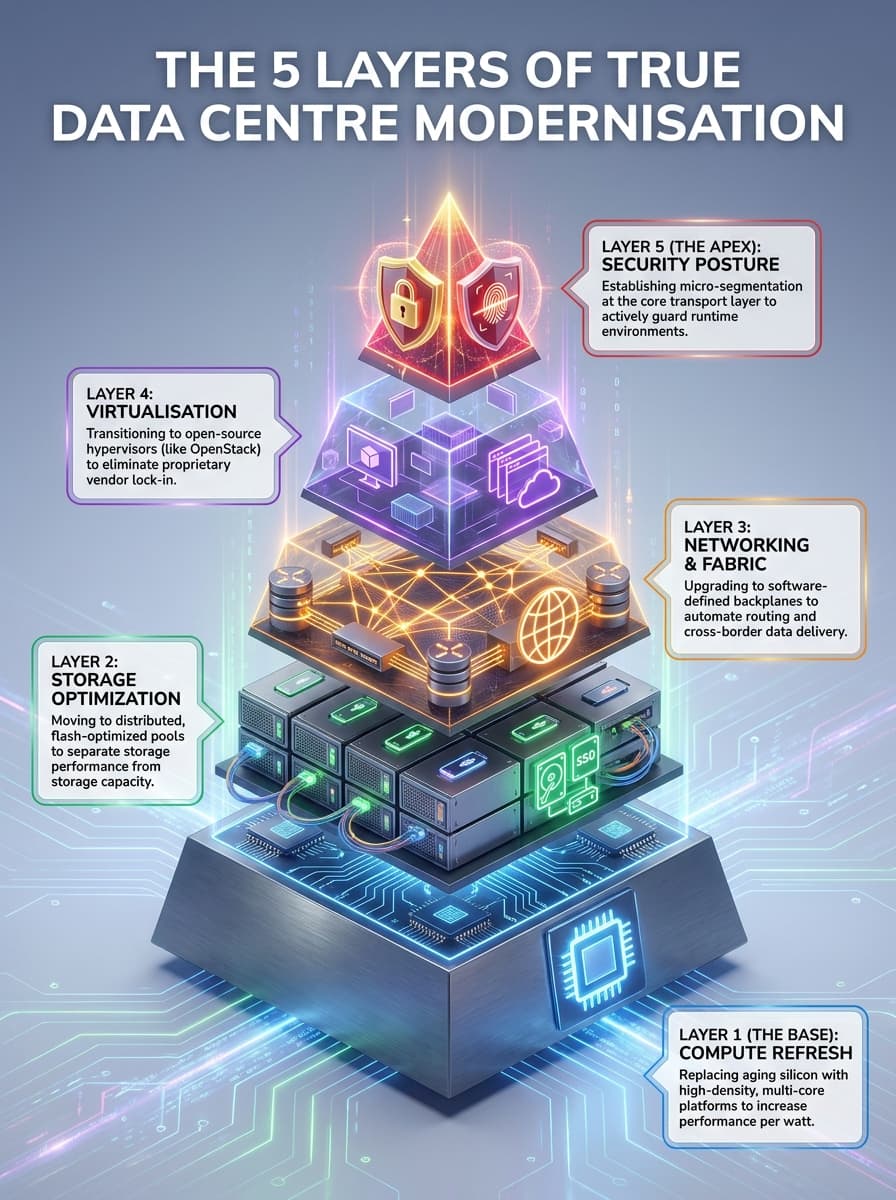
When a business engages data centre modernisation services, the roadmap must expand beyond physical box replacement. True modernisation requires structural modifications across five distinct operational layers.
- Compute Refresh: Replacing aging silicon footprints with modern multi-core server platforms that compress the physical footprint while increasing performance per watt.
- Virtualisation Layer: Evaluating hypervisor dependencies and introducing open-source software abstractions like OpenStack to eliminate multi-year vendor lock-in.
- Networking and Fabric: Upgrading network backplanes to software-defined models that automate routing and optimize cross-border data delivery paths.
- Storage Optimization: Transitioning away from monolithic storage area networks (SAN) to distributed, flash-optimized pools that separate storage performance from storage capacity.
- Security Posture: Establishing micro-segmentation within the core host transport layer, turning the infrastructure into an actively guarded environment.
Maintaining a resilient infrastructure requires a clear understanding of your underlying topology. Mid-market companies often find that building a stable footprint requires adopting a verified blueprint, such as the corporate it infrastructure framework for mid-size enterprises. This foundation ensures your compute and physical hosting parameters match your actual business volumes. Furthermore, protecting data pathways requires implementing a local, multi-cloud strategy that integrates data security directly into the compute fabric. Teams can look to an infrastructure security first multicloud playbook to build ironclad runtime barriers that prevent lateral threat movement across distinct network clusters.
Server virtualisation as a modernization foundation: what it changes and what it leaves behind
Virtualization remains the primary abstraction layer for enterprise IT. However, legacy server virtualization platforms often function as golden cages. They simplify provisioning but lock the enterprise into proprietary application program interfaces (APIs) and storage formats.
Modern virtualization must step outside these single-vendor ecosystems. Moving to an open-source virtualization orchestration platform like OpenStack provides the exact same high-availability clustering and runtime performance as legacy stacks, but strips out the recurring license overhead. This transition turns virtual compute resources into a true utility model.
Private Cloud Hosting Definition
Private cloud hosting is a dedicated infrastructure model where compute, storage, and network resources are isolated for a single enterprise tenant. Unlike public clouds, it ensures total data sovereignty, zero multi-tenant noise, and fully auditable perimeter control.
IT leaders must look past marketing definitions when selecting a target architecture. For organizations that handle highly regulated data, the public cloud introduces massive egress cost penalties and unpredictable performance swings. Understanding what private cloud hosting services provide clarifies why companies prefer dedicated infrastructure for core workloads, ensuring deep operational security and total baseline control over the processing stack.
The assessment-first methodology: how an architectural roadmap starts before touching hardware
A real infrastructure modernization strategy never begins with an unboxing video. It starts with non-invasive software data compilation to map out the hidden realities of the network. Box-shippers skip this phase because they want to invoice physical goods immediately. An operational partner spends weeks mapping reality before a single power cord is pulled.
- Automated Inventory Discovery: Deploying monitoring agents across the infrastructure to compile an exhaustive list of running assets, including operating system patch levels and hypervisor versions.
- Logical Dependency Mapping: Analyzing active packet traffic to visualize how applications talk to databases, ensuring no legacy software integration is orphaned during migration.
- Performance Metrics Baseline: Tracking real-world memory, CPU utilization, and IOPS thresholds over full business cycles to prevent unnecessary system over-provisioning.
- TCO and OpEx Modeling: Translating raw performance footprints into a structured operational cost framework, replacing capital-heavy outlays with predictable resource subscription fees.
Bypassing this phase guarantees configuration matching errors during data cutover. IT leaders can utilize dedicated it infrastructure capacity planning models to size their target environment around objective resource tracking data. This alignment cuts out vendor margin padding and matches future processing scale with exact data center space limitations.
Phased execution: modernising critical architecture without taking business operations offline
The biggest fear keeping any infrastructure manager awake at night is extended downtime during database migration. Legacy migration blueprints often rely on “big bang” cutovers, where systems go dark over a weekend while engineers pray the data transforms correctly. This approach is unacceptable for continuous business operations.
Modern execution uses a ring-fenced, phased strategy. Legacy workloads are classified by complexity and risk parameters. Low-risk background tasks migrate first, establishing network validation pathways. Crucial core execution engines move last, using real-time data replication channels that run parallel tracks between the old iron and the modern host platform.
VMware Migration Pathways
Modern server migration uses parallel synchronization tracks to keep systems live during platform transitions. Workloads run uninterrupted on legacy blocks while data updates stream background blocks to the target open hypervisor.
Selecting the correct migration mechanics prevents long data recovery cycles. Engineers must evaluate tactical deployment trade-offs by referencing the mechanics of live vs cold virtualization migration to align runtime variables with strict application availability windows. To ensure zero loss during cutover, this entire transfer sequence must match a resilient protection blueprint. Organizations should ground their operational change roadmap within a documented, proven backup and disaster recovery plan that actually restores, creating automated rollback points at every micro-phase of the network migration.
Choosing an infrastructure modernisation partner: green flags vs reseller red flags
The market is saturated with IT businesses claiming data center modernization capabilities. Most are simply hardware box-shippers wearing an engineering mask. Distinguishing between a product salesperson and an operational outcomes partner requires checking their financial dependencies.
| Reseller Red Flags | Managed Infrastructure Partner Green Flags |
| Proposes hardware lists before doing workload discovery or logical dependency mapping. | Insists on a multi-week discovery phase using passive discovery tracking tools. |
| Pushes proprietary hypervisor stack license locks that enforce future cost dependencies. | Advocates open-source platforms (OpenStack) that offer long-term platform portability. |
| Vanishes from the server room immediately after the physical hardware placement invoice clears. | Assumes complete operational ownership of Day-2 runtime operations, updates, and uptime SLAs. |
Choosing a partner requires looking at how they structure their corporate support models. A product seller drops equipment off and hands over a standard vendor warranty document. If a virtualization cluster hangs at midnight, they point you to an international helpline ticket queue. True engineering continuity requires aligning with a specialized organization. IT infrastructure teams can look to a regional managed cloud services provider selection guide to see how a dedicated infrastructure partner changes the risk equation, providing direct access to senior system engineers who own the operational result. Working with verified local actors, such as an established managed service provider in Singapore, ensures your architecture remains optimized under local multi-datacenter governance rules.
Defining managed operations: what post-modernisation ownership means in practice
Modernization does not end when the migration team logs off. The true lifecycle of an enterprise data center is defined by its ongoing operations. A modernized hypervisor stack requires constant micro-tuning, security patching, and platform governance to retain its performance edge.
Managed operations means your partner assumes accountability for the entire system lifecycle. This includes continuous network trace checking, automated performance tuning, and leading regular resilience tests. If your platform has not conducted a live failover drill in the last six months, you do not have an automated infrastructure plan. You have a hopeful documentation folder.
Technology leaders must treat day-2 operations with the same architectural rigor as the migration itself. Partnering with a specialist for comprehensive it infrastructure management services moves your staff away from the daily low-level patching cycle, allowing internal engineers to focus on business logic customization. By establishing a unified approach to cloud operations management layers, enterprise environments ensure that performance baselines, auditable access trails, and runtime capacities adapt dynamically to actual business volumes.
Navigating the next phase of enterprise infrastructure
Building a reliable infrastructure blueprint demands moving past product sales scripts and box-shipping transactions. True data center modernization services deliver operational resilience, long-term vendor flexibility, and stable runtimes tailored to your business volumes. Technology leaders looking to clean up legacy technical debt can connect with an enterprise infrastructure specialist at Accrets via our contact page to initiate a non-invasive workload assessment, building a predictable operational roadmap that guarantees platform stability without proprietary vendor lock-in.

Dandy Pradana is an Digital Marketer and tech enthusiast focused on driving digital growth through smart infrastructure and automation. Aligned with Accrets’ mission, he bridges marketing strategy and cloud technology to help businesses scale securely and efficiently.