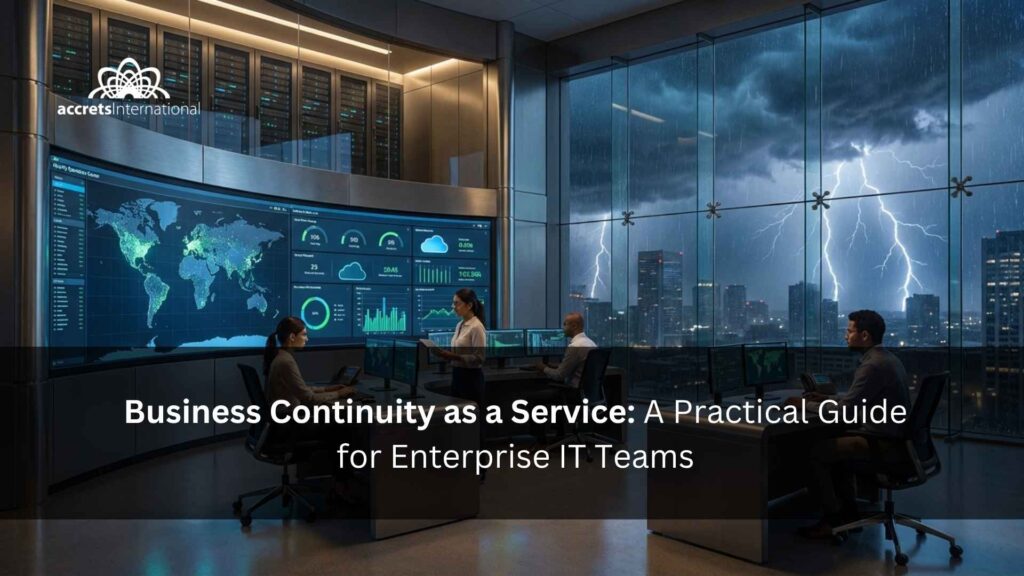

Business Continuity as a Service (BCaaS) is a dynamic, managed approach that ensures your entire organization remains functional, compliant, and secure during critical disruptions. Unlike static recovery plans, BCaaS provides holistic risk management, crisis communications, and operational workarounds to safeguard revenue and reputation.
We invite you to read this guide together with your team until the end to fully understand how to shift from reactive survival to proactive enterprise resilience.
TL;DR: BCaaS goes beyond traditional IT disaster recovery by offering a holistic, fully managed solution to keep your business running during a crisis. It covers risk management, communications, and operational workflows, operating on a predictable OPEX model that provides superior ROI compared to in-house management.
In today’s hyper-connected, always-on global economy, the question is no longer if your enterprise will face a critical operational disruption, but when. From sophisticated ransomware syndicates targeting global supply chains to unexpected natural disasters and critical infrastructure failures, the threat landscape has evolved far beyond the scope of traditional IT backups.
For enterprise IT teams and business leaders, whether operating out of a regional hub in Singapore or managing a distributed workforce across the Americas, the pressure to maintain uninterrupted operations is immense. Yet, many organizations remain stuck in a reactive cycle, scrambling to piece together disparate disaster recovery tools while neglecting the broader operational picture. This is where the paradigm must shift from reactive survival to proactive resilience.
Enter Business Continuity as a Service (BCaaS). Unlike static plans sitting in a binder on a server rack, BCaaS is a dynamic, managed approach to ensuring your entire organization remains functional, compliant, and secure during a crisis. In this practical guide, we will break down exactly what BCaaS includes, how it differs from traditional disaster recovery planning, and what enterprise decision-makers must look for when selecting a long-term managed service provider.
BCaaS vs. DRaaS: Clearing Up the Cloud Confusion
When assessing operational resilience, IT teams frequently conflate Disaster Recovery as a Service (DRaaS) with Business Continuity as a Service (BCaaS). While they are intimately related, treating them as interchangeable is a dangerous operational oversight.
Disaster Recovery as a Service (DRaaS) is fundamentally technology-centric. It focuses on the replication and hosting of physical or virtual servers by a third party to provide failover in the event of a man-made or natural catastrophe. If a server goes down, DRaaS ensures your data is safe and your applications can be spun back up. It is the tactical heartbeat of your IT survival. For organizations evaluating their regional data resilience, implementing robust cloud backup and disaster recovery in Singapore is often the crucial first step.
Business Continuity as a Service (BCaaS), on the other hand, is entirely holistic. It encompasses DRaaS but elevates the scope from the IT department to the entire enterprise. BCaaS asks the broader questions: Once the servers are restored, where do the employees work? How do we communicate with stakeholders? How do we manage the PR fallout? What manual workarounds exist for our supply chain?
A comprehensive BCaaS solution delivers:
- Holistic Risk Management: Identifying vulnerabilities across HR, facilities, supply chain, and IT.
- Crisis Communications: Pre-defined protocols for internal and external stakeholder management.
- Operational Workarounds: Documented procedures to keep the business generating revenue even while IT systems are being restored.
Simply put: DRaaS saves your data, BCaaS saves your business.
The Core Lifecycle of Expert-Led Continuity
Traditional continuity planning often fails because it is treated as a one-time project rather than a continuous lifecycle. Partnering with a managed BCaaS provider transforms this static document into a living, breathing operational safeguard. The lifecycle of expert-led continuity generally follows three rigorous phases:
1. Strategic Planning and Analysis
Before any technology is deployed, a seasoned BCaaS provider conducts a comprehensive Business Impact Analysis (BIA) and develops extensive Risk Registers. This phase identifies your organization’s most critical functions, the resources required to support them, and the financial and operational impact of their disruption. This foundational step is the bedrock of effective business continuity planning and disaster recovery (BCP & DR), ensuring that capital is allocated to protecting your most vital assets first.
2. Implementation and Engineering
With the BIA complete, the focus shifts to drafting actionable IT Disaster Recovery Plans and setting strict Recovery Time Objectives (RTO) and Recovery Point Objectives (RPO). This phase involves architecting the physical and cloud infrastructure required to meet these metrics. Providers will implement failover mechanisms, redundant communication channels, and secure data vaults, ensuring that the theoretical plan has the technical backing to execute flawlessly.
3. Testing, Rehearsals, and Optimization
A continuity plan that hasn’t been tested is merely a hypothesis. The true value of BCaaS lies in scheduled, managed testing. This ranges from tabletop exercises with executive leadership to full-scale, simulated failover rehearsals. By constantly testing the environment against emerging threats, your BCaaS provider ensures the strategy evolves alongside your business and the global threat landscape.
Pricing Benchmarks: The True ROI of BCaaS vs. In-House Management
One of the most significant barriers to enterprise resilience is the perceived cost. However, decision-makers must evaluate the true Total Cost of Ownership (TCO) when comparing an in-house Business Continuity Management (BCM) team against a managed BCaaS model.
Building an internal continuity team requires hiring certified, senior-level BCM professionals (e.g., CBCP or MBCI certified), investing in proprietary BCM software licenses, and constantly training staff to maintain compliance with global standards like ISO 22301 or SOC 2. Furthermore, managing the underlying infrastructure can quickly drain capital expenditure budgets.
Conversely, BCaaS operates on a predictable Operating Expense (OPEX) model. By leveraging the economies of scale provided by a managed service, enterprises gain fractional access to top-tier continuity experts and enterprise-grade software without the overhead of full-time salaries. For growing organizations looking to optimize their investments, establishing a predictable, managed corporate IT infrastructure in Singapore and the wider APAC region often yields a vastly superior ROI compared to the hidden costs and compliance risks of managing resilience internally.

Real-World Resilience: Surviving a 48-Hour Ransomware Attack
To understand the tangible value of BCaaS, consider the real-world scenario of a mid-sized global logistics firm targeted by a sophisticated ransomware syndicate. Operating on a hybrid infrastructure, the firm woke up to find its primary ERP system and local backups entirely encrypted. The ransom demand was in the millions.
Because the firm had partnered with a BCaaS provider, panic did not set in. The response was clinical and immediate:
- Isolation: The provider’s Security Operations Center (SOC) instantly isolated the infected networks, preventing lateral movement across global branches.
- Communication: Pre-drafted crisis communication plans were activated, notifying clients of a temporary tracking delay without inducing panic.
- Recovery: Utilizing immutable cloud backups, the provider initiated the failover sequence. Because strict RTOs and RPOs had been established and tested, critical dispatch applications were restored within 4 hours.
- Continuity: While the primary IT environment was being forensics-cleansed over the next 48 hours, the logistics firm operated seamlessly from the provider’s secure cloud environment.
This outcome wasn’t an accident, it was the result of meticulous planning and robust infrastructure security in cloud computing. The business avoided paying the ransom, suffered zero data loss, and maintained its reputation in a highly competitive market.
The Objective Vendor Selection Checklist
Not all managed service providers are created equal. When your enterprise’s survival is on the line, you must demand a partner capable of executing under extreme pressure. If you are evaluating a move to a managed continuity model, use this 5-point vendor selection checklist:
- End-to-End Capability: Does the provider offer holistic BCM consulting alongside technical DRaaS capabilities, or are they just selling backup storage?
- Demonstrable Compliance: Can they prove compliance with rigorous global standards such as ISO 22301 and ISO 27001?
- Strict RTO/RPO Guarantees: Do they mathematically guarantee your Recovery Time Objectives and Recovery Point Objectives through financially backed SLAs?
- Managed Rehearsals: Do they facilitate annual or bi-annual tabletop exercises and technical failover rehearsals to validate the plan?
- Strategic Alignment: Do they act as a strategic extension of your IT team? Understanding exactly why partnering with a managed cloud services provider matters is critical, you need a partner who understands your specific industry nuances, not just a vendor selling a generic software package.
Your Free Interactive Resource: Cloud BCP Readiness Template
The first step toward proactive resilience is understanding exactly where your organization currently stands. You cannot protect what you haven’t identified.
To help enterprise IT teams begin this critical evaluation, we have developed a comprehensive framework designed specifically for modern, cloud-integrated businesses. Before you invest in a managed service, take the time to audit your current environment.
Download our free lead magnet here: Business Continuity Plan Template for Cloud Computing
This template is explicitly designed for global operations and is APAC/US-friendly, allowing you to instantly map out your critical assets, identify immediate single points of failure, and begin structuring your internal risk registers today.
Secure Your Future with Accrets Cloud Experts
When a crisis strikes, your organization shouldn’t be scrambling to read a manual, you should be executing a well-rehearsed strategy alongside seasoned experts.
Accrets provides premier, end-to-end Business Continuity as a Service tailored for global enterprises. We go beyond simple data replication. Our comprehensive IT Disaster Recovery as a Service includes meticulous RTO/RPO planning, continuous architectural optimization, and fully managed, rigorous failover rehearsals. We act as an extension of your IT leadership, ensuring that no matter what the global threat landscape throws at you, your operations remain secure, compliant, and uninterrupted.
Stop leaving your enterprise resilience to chance.
Ready to bulletproof your business operations? Schedule a free DR consultation with an Accrets Cloud Expert today.

Dandy Pradana is an Digital Marketer and tech enthusiast focused on driving digital growth through smart infrastructure and automation. Aligned with Accrets’ mission, he bridges marketing strategy and cloud technology to help businesses scale securely and efficiently.