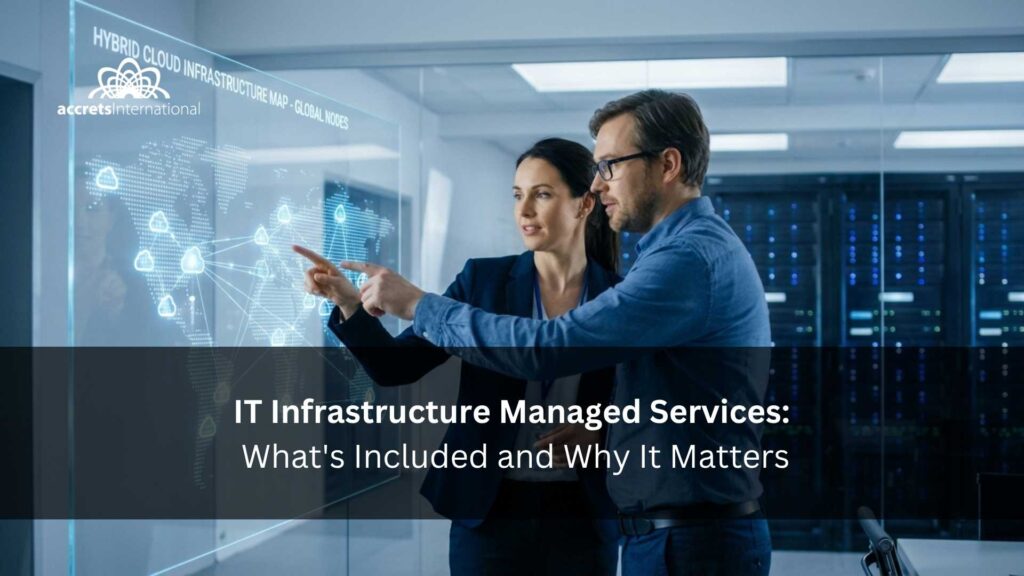

IT infrastructure managed services involve partnering with specialized experts to proactively monitor, secure, and optimize your core technology systems, shifting the operational burden from internal teams to dedicated professionals. This approach covers everything from predictive maintenance and security patching to strict Service Level Agreements (SLAs) and enterprise-grade disaster recovery.
If you are evaluating how to reduce operational costs, bridge the technical skills gap, and scale your hybrid or multi-cloud environment securely, read this guide together with us until the end to discover exactly what is included and how to navigate this transition successfully.
TL;DR: The Quick Breakdown
- The Core Shift: Managed infrastructure moves enterprise IT from a reactive break and fix model to a predictive, architecture-agnostic operation.
- Key Deliverables: A premium agreement includes 24/7 proactive monitoring, automated security patching, strict resolution SLAs, and multi-tiered technical support.
- Business Impact: Outsourcing foundation-level IT frees up your internal talent for innovation, bridges the critical IT skills gap, and converts unpredictable capital expenditures into predictable operational costs.
- The Accrets Advantage: Accrets delivers vendor-agnostic deployment, rehearsal-led disaster recovery, and customized enterprise cloud architecture designed to prevent vendor lock-in.
Most enterprises do not calculate the true cost of self-managed cloud and on-premise hardware until the bill arrives, or worse, until a critical system goes offline. In today’s hyper-connected, multi-cloud reality, managing enterprise architecture has shifted from a routine operational task to a highly complex, risk-laden undertaking. IT leaders are constantly caught in a balancing act: maintaining the lights-on operations of legacy systems while simultaneously trying to drive digital transformation and innovation.
This is where the conversation around IT infrastructure managed services fundamentally changes. It is no longer just about outsourcing your help desk or having a third party reboot a server at 3:00 AM. It is about architectural agility, predictable operational expenditures (OpEx), and ironclad security.
Whether you are evaluating cloud vs on-premise architectures, dealing with unexpected VMware licensing hikes, or trying to secure a hybrid environment, understanding exactly what is IT infrastructure management services is the first step toward reclaiming your IT team’s time. In this comprehensive guide, we are going to break down exactly what a modern managed infrastructure agreement covers, from predictive monitoring to strict Service Level Agreements (SLAs), and explore why transitioning to a partner-led model is the most strategic move an enterprise can make in 2026.
The Modern Definition of IT Infrastructure Managed Services
At its core, IT infrastructure managed services involve delegating the proactive maintenance, monitoring, security, and optimization of your core technology systems to a specialized third-party provider. However, the scope of these services has evolved dramatically.
Historically, managed IT services were reactive. A server went down, an alert was generated, and a technician fixed it. Today, the approach must be predictive and architecture-agnostic. Top-tier managed service providers (MSPs) operate as an extension of your internal team, governing complex multi-cloud deployments, integrating Artificial Intelligence for IT Operations (AIOps), and ensuring compliance with stringent regulatory frameworks like SOC 2, ISO 27001, and MAS TRM.
When you partner with leading managed service providers (MSP) in Singapore or globally, you are not just buying support; you are buying operational maturity, risk mitigation, and immediate access to elite cloud architects.

Breaking Down the Deliverables: What is Actually Included?
When negotiating an infrastructure management contract, clarity is your best defense against scope creep and operational blind spots. A robust managed services agreement should clearly delineate responsibilities across several critical pillars. Here is the definitive breakdown of what enterprise-grade managed IT infrastructure covers.
1. Proactive Monitoring and Alerting (The “Eyes-On” Approach)
Monitoring is the bedrock of any reliable infrastructure. However, simply installing a monitoring agent on a virtual machine is no longer sufficient. Enterprise best tools for IT infrastructure monitoring services now rely on deep observability.
- Continuous Performance Tracking: A managed provider continuously tracks CPU, memory, disk I/O, and network latency across your entire stack, whether that data resides in an Equinix data center, AWS, Azure, or a private OpenStack environment.
- Predictive Analytics and AIOps: Instead of waiting for a disk to fail or a network switch to hit 100% capacity, modern monitoring utilizes predictive analytics. By analyzing historical telemetry data, the MSP can identify an impending failure and reroute traffic or provision additional resources before the user experiences any latency.
- Noise Reduction: One of the greatest challenges for internal IT teams is “alert fatigue.” A mature managed service filters out false positives, ensuring that when an engineer is paged, the incident is legitimate, critical, and actionable.
2. Security Patching and Lifecycle Management
Vulnerability management is the single most critical, yet frequently neglected, aspect of internal IT operations. Hackers do not typically breach networks through sophisticated zero-day exploits; they walk through the front door via unpatched, known vulnerabilities.
- Automated and Scheduled Patching: A managed service ensures that critical security patches for operating systems (Windows, Linux), hypervisors, and core networking equipment are tested in a sandbox environment and deployed seamlessly during designated maintenance windows.
- Version Control and Firmware Updates: Beyond software, underlying hardware and firmware must be kept up to date to prevent compatibility issues. Your MSP tracks the entire lifecycle of your infrastructure, alerting you well in advance of End-of-Life (EOL) or End-of-Support (EOS) milestones so you can plan capital expenditures accordingly.
- Hardening against Frameworks: Patching is just one part of the equation. Your provider should configure your environments according to the top 3 best practices for IT infrastructure management, ensuring alignment with the Center for Internet Security (CIS) benchmarks or your specific industry compliance requirements.
3. Strict Service Level Agreements (SLAs) and Metrics That Matter
An SLA is the contractual heartbeat of your relationship with a managed service provider. It dictates the financial and operational accountability of the vendor. When evaluating providers, you must look past generic “99.9% uptime” guarantees and demand transparency on the metrics that actually impact your business.
- Uptime vs. Application Availability: Is the provider guaranteeing that the physical server is powered on, or are they guaranteeing that your mission-critical ERP system is accessible to end-users? A true enterprise partner guarantees the latter.
- Mean Time to Respond (MTTRespond): This guarantees how quickly an engineer will acknowledge a high-severity incident. For critical systems, this should be measured in minutes, not hours.
- Mean Time to Resolution (MTTResolve): The holy grail of SLAs. This dictates how quickly the provider guarantees the issue will be fixed and operations restored.
- Penalties and Service Credits: A meaningful SLA must have teeth. If the provider fails to meet the agreed-upon metrics, there must be a transparent mechanism for financial recourse.
4. Multi-Tiered Technical Support (The Escalation Matrix)
Not all IT issues require a senior cloud architect, but when a massive database corruption occurs, you cannot afford to have a junior technician reading off a script. Managed IT infrastructure includes a structured, multi-tiered support system designed to route issues to the correct expertise immediately.
- Tier 1 (L1) Level Triage: This is the 24/7/365 frontline help desk. They handle basic alerts, password resets, user provisioning, and initial triage of network alerts. Their goal is rapid resolution of known, documented issues.
- Tier 2 (L2) Advanced Troubleshooting: If an issue cannot be resolved by standard operating procedures, it escalates to L2. These are experienced systems administrators and network engineers who dig into logs, troubleshoot complex routing issues, and resolve deeper systemic problems.
- Tier 3 (L3) Architecture and Engineering: This tier comprises the heavy hitters, such as Senior Solutions Architects, Security Operations (SecOps) leads, and Database Administrators. They handle critical outages, architectural redesigns, and complex performance tuning.
- Account Management (TAM): Beyond technical support, enterprise managed services include a Technical Account Manager (TAM) or Virtual CIO (vCIO). They hold quarterly business reviews (QBRs) to align your IT infrastructure with your long-term business goals.
Why Moving to Managed Infrastructure Matters for the Enterprise
If you are a CIO or IT Director reading this, you already know the technical merits. But how do you justify the transition to the board? Here is why adopting a managed infrastructure model is a business imperative, not just an IT convenience.
Shifting Focus from Maintenance to Innovation
Internal IT teams are often highly paid, brilliant engineers who spend 70% of their week resetting VPN tunnels, patching servers, and staring at monitoring dashboards. By outsourcing the foundational layer of your infrastructure, you free up your most expensive intellectual capital. Your engineers can stop maintaining the status quo and start focusing on revenue-generating projects like developing new customer-facing applications, optimizing data analytics pipelines, and driving digital transformation.
Bridging the IT Skills Gap
The global talent shortage in specialized IT fields, particularly in cloud architecture, cybersecurity, and DevOps, is staggering. Recruiting, training, and retaining a Tier-3 OpenStack or Azure architect is incredibly expensive. By partnering with a managed service provider, you instantly gain fractional access to an entire bench of certified experts for a predictable monthly fee. This is particularly crucial for businesses seeking robust business IT support in Singapore: a US decision makers field guide to bridge trans-pacific operational gaps.
Predictable Cost and Avoiding Vendor Lock-In
Public hyperscalers offer immense scalability, but their billing models are notoriously opaque. Data egress fees and idle compute resources can cause cloud bills to spiral out of control. Furthermore, heavy reliance on native hyperscaler tools leads to vendor lock-in, making it painfully expensive to migrate away. A truly consultative managed infrastructure partner acts as an architect-agnostic broker. They help you build environments using open standards, effectively balancing workloads between cost-effective private clouds and scalable public clouds, keeping your operational expenses entirely predictable.
The Accrets Advantage: Delivering Enterprise-Grade Managed Operations
At Accrets, we recognize that one cloud does not fit all. We are not just a cloud reseller; we are an enterprise infrastructure partner built to solve complex architectural challenges. For organizations spanning the globe but anchored in Southeast Asia, our approach to managed IT infrastructure is fundamentally different.
- Architecture-First Philosophy: We do not force your workloads into a pre-packaged box. Whether you need a secure private cloud to escape VMware licensing lock-in, highly customized SAP Business One hosting, or cross-border connectivity into China via Teridion, we design the architecture around your exact business requirements.
- Rehearsal-Led Disaster Recovery: A DR plan is only as good as your last successful test. Accrets goes beyond traditional backups by offering rehearsal-led Disaster Recovery as a Service. We routinely simulate failovers, proving our SLAs and ensuring that if a catastrophe strikes, your business recovery is guaranteed, not theoretical.
- Vendor Agnostic, Business Aligned: We operate carrier-neutral deployments across premier Tier-3 facilities like Equinix. Our managed services are built to give you flexibility, security, and resilience without tying your hands to a single vendor’s ecosystem.
Secure Your Infrastructure’s Future
Managing infrastructure should not be a distraction; it should be the invisible, unshakable foundation that powers your enterprise’s growth. If your IT team is bogged down by daily maintenance, or if you are losing sleep over patching schedules and compliance audits, it is time to change the operational model.
Stop managing infrastructure complexity and start driving business outcomes. Request a managed services proposal today to see exactly how Accrets can streamline your operations, secure your data, and optimize your cloud spend.
Fill out the form below for a free consultation with an Accrets Cloud Expert to scope your environment:

Dandy Pradana is an Digital Marketer and tech enthusiast focused on driving digital growth through smart infrastructure and automation. Aligned with Accrets’ mission, he bridges marketing strategy and cloud technology to help businesses scale securely and efficiently.