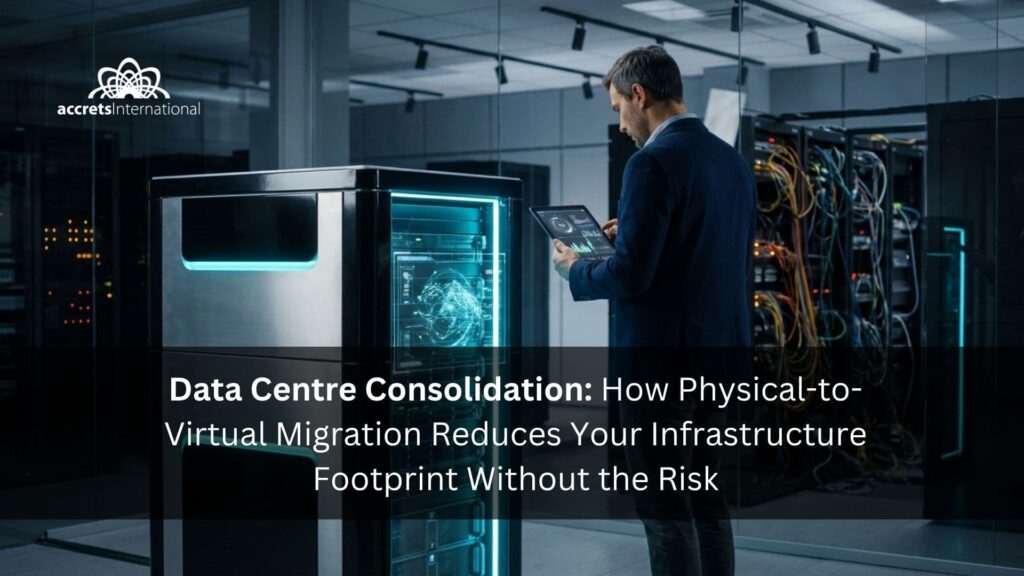

Data center consolidation services utilize Physical-to-Virtual (P2V) migration to successfully transition legacy physical servers into highly dense, virtualized environments. This systematic process significantly reduces your physical infrastructure footprint, lowers operational costs, and mitigates hardware risks while paving a clear path for hybrid cloud adoption. If you want to understand the exact roadmap for executing a seamless and risk-free consolidation, read on as we break down every technical step, best practice, and proven strategy below.
TL;DR
- Data center consolidation cuts costs and footprint by moving workloads from physical hardware to virtual machines (P2V).
- Comprehensive planning requires an accurate workload inventory, dependency mapping, and risk-level prioritization.
- Running a parallel environment ensures zero risk to live production workloads during the final cutover.
- Post-migration management shifts the IT focus from physical hardware maintenance to hypervisor and virtual resource optimization.
- Success is explicitly measured by a reduced Total Cost of Ownership (TCO), lower physical server counts, and improved SLA performance.
By Joshua Tan, Lead Cloud Architect at Accrets, Assisted by Dandy.
With over a decade of experience designing and managing enterprise IT environments across the APAC region and globally, Joshua Tan specializes in risk-averse infrastructure modernization and hybrid cloud architectures.
What is P2V Data Centre Consolidation?
Data centre consolidation via Physical-to-Virtual (P2V) migration is the technical process of decoupling operating systems, applications, and data from legacy physical hardware and hosting them as virtual machines (VMs) on a dense, hyper-converged infrastructure. This mechanism drastically reduces physical server footprints, lowers licensing and cooling costs, and provides a highly scalable foundation for hybrid cloud integration.
1. The Business Case for Consolidation: Escaping the Hardware Trap
For years, the standard approach to enterprise growth was simple: new application, new server. Over time, this hardware-centric mindset has led to massive IT sprawl. Racks fill up with underutilized machines running at 15% to 20% capacity, yet they still consume 100% of the power, cooling, and floor space.
The business case for data centre consolidation is rooted in eliminating this profound inefficiency. When you consolidate your infrastructure, you are not just reorganizing cables; you are fundamentally altering your operational expenditure (OpEx) and capital expenditure (CapEx) models.
By migrating workloads off aging bare-metal servers, enterprises achieve significantly fewer physical servers to maintain. This immediately translates to lower energy consumption and reduced data centre rack space rentals. Furthermore, fewer physical CPUs often mean lower enterprise software licensing costs, as many core-based licenses can be optimized in a virtualized environment.
Beyond immediate cost savings, consolidation shrinks your disaster recovery footprint. Protecting 50 physical servers requires a massive, mirrored physical site. Protecting 50 virtual machines requires a fraction of the storage and compute, making your business continuity planning and disaster recovery (BCP/DR) vastly more efficient and cost-effective. Whether you are mapping out corporate IT infrastructure in Singapore or managing a global footprint, consolidation is the first step toward reclaiming your IT budget.
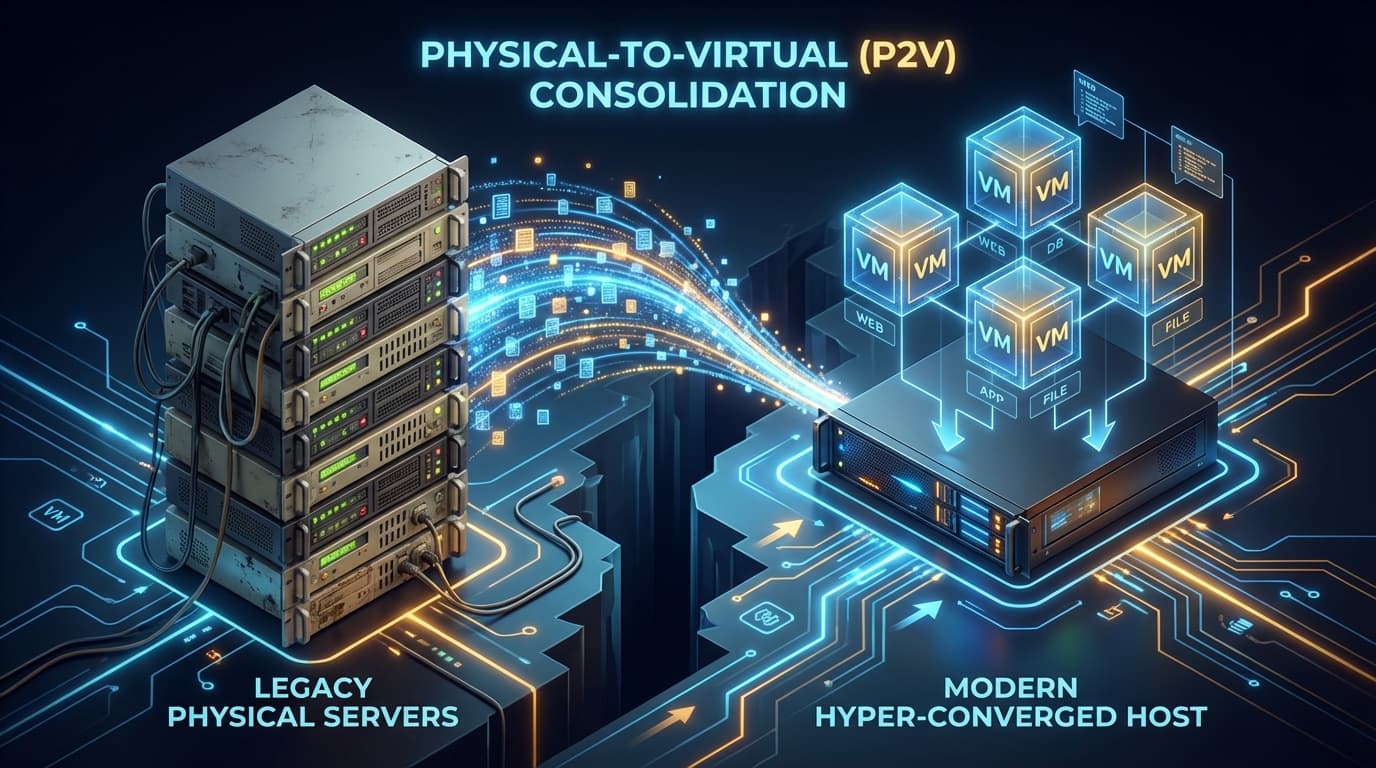
2. Physical-to-Virtual (P2V) Migration as the Consolidation Mechanism
While many executives understand why they need to consolidate, the SERPs are surprisingly quiet on how it actually gets done. The technical engine driving modern data centre consolidation is the Physical-to-Virtual (P2V) migration.
In a traditional setup, the operating system (OS) is tightly bound to the physical motherboard, CPU, and network interface cards. P2V migration breaks this bond. Using specialized migration tools, the entire state of a physical machine – its OS, applications, data, and configurations – is cloned and converted into a Virtual Machine (VM) disk image. This VM is then booted up on a hypervisor (like VMware or an OpenStack alternative) running on dense, high-performance host servers.
What P2V Achieves:
- Extreme Density: You can routinely collapse 10 to 20 aging physical servers onto a single, modern host server.
- Hardware Independence: Because the VM is essentially just a set of files, it no longer cares about the underlying hardware. If a physical host dies, the VM can simply be restarted on another host in the cluster.
- Agility: Provisioning a new server goes from a weeks-long procurement and racking process to a five-minute software deployment.
Understanding the mechanics of P2V is vital when navigating the broader cloud vs on-premise debate, as virtualizing your workloads is the prerequisite for pushing them into a private or public cloud later.
3. The Consolidation Planning Process: Map Before You Move
A successful P2V consolidation is won or lost long before the first byte of data is transferred. You cannot migrate what you do not understand, and relying on outdated configuration management databases (CMDBs) is a recipe for catastrophic downtime.
To execute a flawless consolidation, you must engage in a rigorous, three-phase planning process:
A. Workload Inventory
You must run automated discovery tools to audit your entire environment. This answers the basic questions: How many servers do we have? What operating systems are they running? What are their peak CPU, RAM, and storage IOPS utilization rates? This data ensures you right-size the target virtual environment, preventing you from over-provisioning and wasting money.
B. Dependency Mapping
This is where most internal IT teams struggle. Server A might look like a standalone web server, but it actually relies on a legacy database on Server B and an authentication protocol on Server C. If you migrate Server A without migrating its dependencies simultaneously, the application will break. Dependency mapping visualizes these complex interconnections so you can group servers into cohesive migration waves. If you lack the internal resources for this, engaging in expert cloud migration strategy consulting is highly recommended.
C. Prioritisation by Risk Level
Not all workloads are created equal. We recommend starting your P2V migrations with low-risk, non-critical environments (like UAT or staging servers) to validate the methodology. Only once the process is proven do you move on to mission-critical, Tier-1 production databases.
4. How to Run a Parallel Environment During Consolidation
The greatest fear any CIO has during a data centre consolidation is negatively impacting production workloads. How do you move the engine while the car is driving down the highway? The answer is the parallel-run methodology.
Instead of shutting down the physical server, taking a copy, and hoping the new VM turns on perfectly, a parallel environment allows for risk-free validation.
Here is how it works in practice: The target virtual infrastructure is built alongside the existing physical environment. Using block-level replication tools, the data from the physical server is continuously synced to the new VM in the background, without interrupting the live physical server.
Once the initial sync is complete, the IT team can spin up the VM in an isolated network bubble. This allows application owners to log in, test the software, and verify performance in the new virtual state – all while the actual business continues to operate on the original physical server.
Only when the business signs off on the VM’s performance do you schedule a brief maintenance window. You perform a final delta sync, shut down the physical server, update the DNS and network routing, and bring the VM live. If anything goes wrong, rolling back is as simple as turning the physical server back on.
5. Common Consolidation Mistakes to Avoid
Even with the right technology, human error and poor project management can derail a consolidation effort. Over our years of executing these migrations across the APAC region, we have identified three common pitfalls:
- Rushing the Cutover: Attempting to migrate too many servers in a single weekend window usually leads to exhaustion, overlooked errors, and extended Monday-morning downtime. Stick to well-planned, manageable migration waves.
- Skipping Validation: Assuming that because a P2V tool said the process is complete means the application actually works. Infrastructure teams must mandate that application owners sign off on the isolated parallel environment before the final cutover is approved.
- Underestimating Networking Changes: P2V migration is rarely just a storage and compute project; it is heavily reliant on networking. IP addresses may need to change, VLANs must be stretched, and firewall rules must be updated. Failing to map out the new network topology will result in VMs that boot up perfectly but cannot communicate with the outside world.
6. What Post-Consolidation Managed Operations Looks Like
Consolidating your data centre via P2V is not the finish line; it is a new starting point. The way you manage a highly dense, virtualized environment is fundamentally different from managing a room full of physical servers.
Pre-consolidation, IT teams spend a disproportionate amount of time on hardware-level tasks: replacing failed hard drives, checking physical cables, and managing disparate warranty contracts.
Post-consolidation, the physical footprint is minimal, but the virtual complexity increases. Because 20 VMs might be sharing a single physical host, a problem with that host’s storage array or network adapter can now impact 20 applications simultaneously.
Therefore, post-consolidation management requires advanced monitoring tools that can see through the hypervisor layer to identify noisy neighbor VMs that are hogging resources. This operational shift often prompts businesses to reconsider their internal capabilities. Partnering with managed IT services providers who specialize in virtualized and hybrid environments ensures that the newly consolidated infrastructure remains optimized, patched, and secure, allowing your internal team to focus on business-facing applications rather than hypervisor maintenance.
7. How to Measure Consolidation Success
A project is only successful if you can prove the return on investment (ROI). Post-migration, leadership will expect clear metrics demonstrating that the disruption was worth the effort.
Track these three key performance indicators (KPIs) to measure your consolidation success:
- Total Cost of Ownership (TCO) Reduction: Calculate the drop in monthly power and cooling bills, the reduction in data centre rack space lease costs, and the savings from retired hardware maintenance contracts.
- Server Count and Density Ratios: Document the exact number of physical servers retired. Look at your new consolidation ratio (e.g., achieving 15 VMs per physical host).
- SLA Performance and Uptime: Virtualization brings high availability (HA). Measure your application uptime post-migration. With HA features native to virtualized environments, your service level agreements (SLAs) should show marked improvement.
Ready to Optimize Your Infrastructure Footprint?
Data centre consolidation through P2V migration is the most effective way to eliminate IT sprawl, reduce operational costs, and prepare your enterprise for a hybrid cloud future. However, executing it flawlessly requires meticulous dependency mapping, parallel-run testing, and deep architectural expertise.
Do not let legacy hardware dictate your IT budget. Fill the form below for a free consultation with an Accrets Cloud Expert for data centre consolidation services. We will discuss your current footprint, assess your technical risks, and outline a tailored roadmap for your business.
Get a Consolidation Scoping Call Here

Dandy Pradana is an Digital Marketer and tech enthusiast focused on driving digital growth through smart infrastructure and automation. Aligned with Accrets’ mission, he bridges marketing strategy and cloud technology to help businesses scale securely and efficiently.