
A successful VMware to OpenStack migration requires more than just moving data; it demands a strategic shift in organizational processes. While technical tools for converting virtual machines are highly mature, the true challenges lie in bridging internal skills gaps, managing procurement cycles, and handling post-migration operations. By adopting a parallel environment strategy and partnering with managed service experts, enterprises can safely navigate this transition without production downtime.
TL;DR
- The Real Problem: Migrations fail due to internal friction and skills gaps, not technical limitations.
- The Business Case: You must accurately quantify Broadcom licensing savings against the hidden operational costs of OpenStack.
- The Strategy: Use a parallel environment approach to guarantee zero production disruption and a clear rollback path.
- The Reality: Day 2 operations require intense management. Relying on specialized managed IT services ensures long-term stability and success.
Let us address the elephant in the room: the recent Broadcom licensing changes have fundamentally rewritten the rules of enterprise infrastructure. What was once a predictable, manageable line item in the IT budget has suddenly transformed into a catalyst for mass migrations. IT directors and CIOs around the globe are scrambling to re-evaluate their virtualization strategies, and OpenStack is rapidly emerging as the leading destination for those seeking to reclaim control over their environments and avoid vendor lock-in.
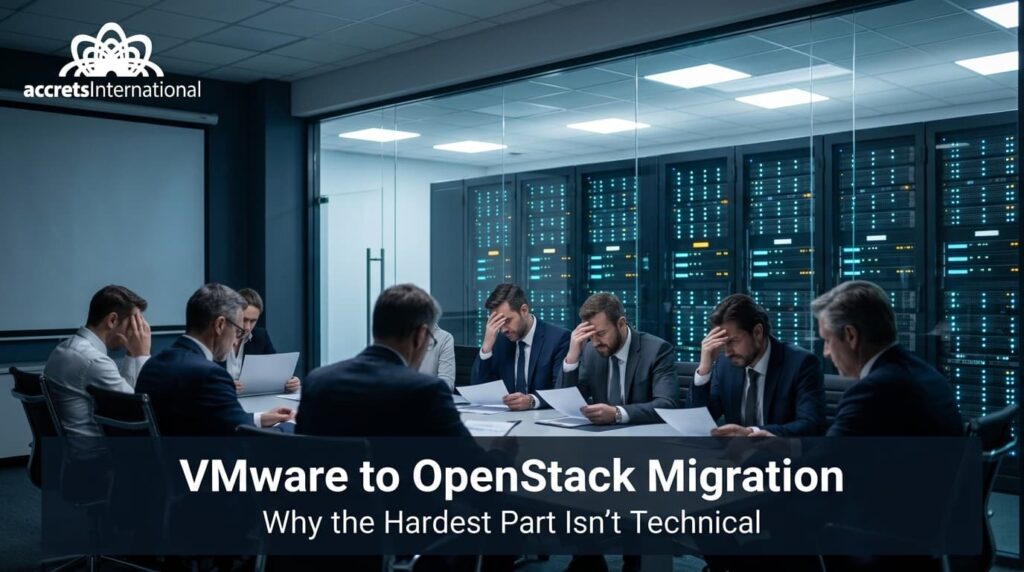
However, if you search for guidance on how to execute this move, you will find an endless sea of server scripts, command-line tutorials, and hypervisor technical documentation. While that information is certainly useful for your engineering team, it entirely misses the point for the C-suite. The harsh reality is that enterprise cloud migrations rarely fail because of a faulty script or a botched VMDK conversion. They fail because of organizational friction, misaligned stakeholders, and a profound underestimation of the talent required to operate a new environment. If you want your transition to succeed, you must stop treating it strictly as an engineering problem and start managing it as an organizational transformation.
The Technical Problem is Solved (The Organizational One Isn’t)
The tools required to convert virtual machines and translate networking from VMware to OpenStack are highly mature and readily available. The true barriers to a successful migration are not technical; they are deeply rooted in internal skills gaps, stakeholder misalignment, and procurement cycles that fail to adapt to open-source realities.
If you ask a seasoned systems administrator about moving from ESXi to KVM, they will quickly point you to established tools like Coriolis or Red Hat’s migration toolkits. The software exists to automate the bulk of the heavy lifting. VMDKs can be converted, networking topologies can be mapped, and storage protocols can be translated. In fact, if your engineering teams are simply looking for the technical runbook on how to handle the backend data, they can easily review specialized guides on VMware storage migration to understand the precise mechanics.
But as a technology leader, your primary concern should not be the mechanics of the data transfer. Your concern is enterprise risk management. The moment you shift focus away from the technical execution, the real challenges materialize. How do you align a procurement department, used to signing three-year enterprise licensing agreements, with the dynamic resource allocation of an open-source private cloud? How do you convince business unit leaders that the temporary disruption of a migration window is worth the long-term agility?
Most importantly, what happens when the migration tool finishes its job, and your internal team is suddenly staring at a Horizon dashboard instead of the vCenter interface they have known for a decade? These are the organizational hurdles that stall projects for months. Overcoming them requires a shift in perspective. You must stop asking “How do we move the data?” and start asking “How do we equip our organization to thrive in a post-VMware ecosystem?”
Building the Internal Business Case: Quantifying Broadcom Savings vs. OpenStack Costs
You cannot successfully lead an infrastructure overhaul without an airtight, mathematically defensible business case. When presenting to the Board of Directors, vague promises of “open-source freedom” will not secure budget approval. You must speak the language of CapEx, OpEx, and total cost of ownership (TCO).
To build a compelling business case, you must accurately compare the predictable but newly inflated costs of legacy VMware licensing against the initial capital expenditure and long-term operating costs of OpenStack. Start by calculating your current VMware spend under the new Broadcom per-core subscription models. For many enterprises, this alone represents a massive increase in operating expenses. This figure is your baseline risk.
Next, you must map the cost of the OpenStack alternative. While the software itself does not carry crippling licensing fees, it is not “free” to run. Your business case must account for the hardware required to host the environment, the network infrastructure to support it, and crucially, the human capital needed to design and maintain it. This is where many internal proposals fail. They underestimate the hidden costs of talent acquisition. Hiring senior OpenStack architects in today’s competitive market is expensive and time-consuming.
A robust framework for this business case should look like this:
- Immediate Cost Avoidance: Document the projected 3-year cost of staying with VMware under the new licensing terms.
- Transition Costs: Detail the one-time expenses for the migration effort, including parallel hardware running during the transition and external consulting fees.
- Day 2 Operational Costs: Honestly assess the cost of operating OpenStack. This is where it often makes financial sense to evaluate a fully managed model rather than building an in-house team from scratch.
During this initial financial capacity planning phase, it is highly recommended that leadership teams thoroughly explore all viable VMware alternatives to ensure that OpenStack is the precise fit for your specific workloads, regulatory requirements, and long-term financial modeling.
Translating VMware Skills to OpenStack Reality
The single biggest anxiety blocking open-source adoption is the IT skills gap. Your internal infrastructure team has likely spent the last five to ten years mastering the intricacies of vSphere, vCenter, and ESXi. They have muscle memory for troubleshooting HA clusters and managing DRS rules. Moving to OpenStack introduces a completely new lexicon and architectural philosophy.
You must systematically translate what your team already knows into OpenStack concepts. Compute is no longer just a host; it is managed by Nova. Storage is not just a datastore; it is orchestrated through Cinder (for block storage) and Swift (for object). Networking shifts from standard vSwitches to Neutron. The underlying principles of virtualization remain the same, but the control plane is entirely different.
To illustrate how critical this translation is, consider a recent transition we facilitated. When advising a Singapore-based mid-size enterprise, a high-growth SaaS provider heavily reliant on uninterrupted uptime, on their infrastructure transition, the initial internal resistance was massive. Their engineering team felt completely out of their depth. Rather than forcing them through generic training modules, we ran workshops that directly mapped their existing vCenter workflows to OpenStack equivalents. By bridging this specific knowledge gap and showing them that their foundational knowledge was still valid, we reduced deployment friction by an estimated 40%.
However, upskilling takes time, and business operations cannot pause while your team learns a new platform. This is where specialized managed IT services become a strategic asset rather than just an outsourced vendor. Bringing in a managed partner to co-pilot the environment during the critical first six to twelve months ensures stability while your internal team safely builds their OpenStack competency.
The Parallel Environment Strategy: Zero Production Disruption
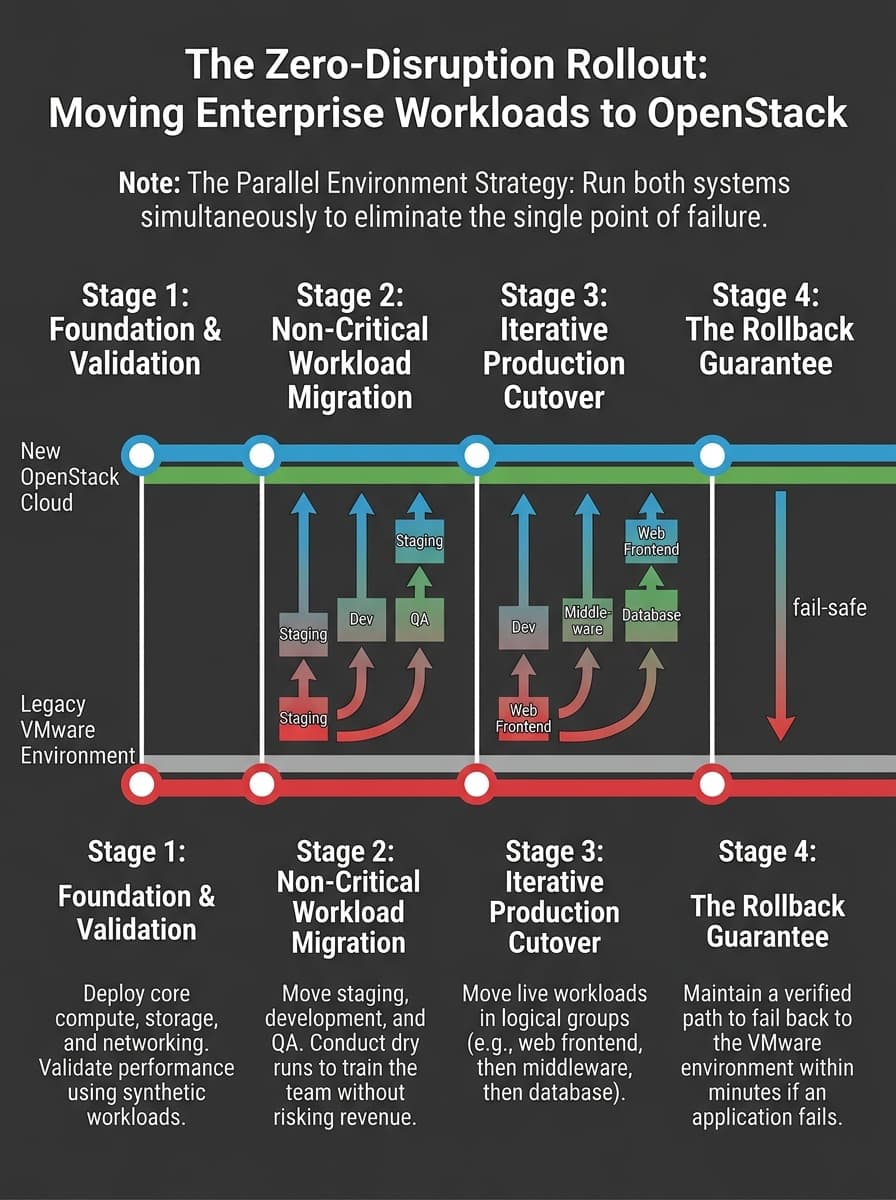
For a CIO, the ultimate nightmare is production downtime. An aggressive “rip-and-replace” cutover over a single weekend is a gamble that enterprise businesses simply cannot afford to take. The only safe, architecturally sound way to migrate mission-critical workloads is through a Parallel Environment Strategy.
This strategy involves standing up your new OpenStack cloud while your existing VMware environment continues to run your production workloads completely uninterrupted. By running parallel environments, you eliminate the pressure of a single “point of no return.”
A structured, zero-disruption rollout should follow these staged steps:
Stage 1: Foundation and Validation:
- Deploy the core OpenStack infrastructure (compute, storage, networking) and validate it using synthetic workloads. Ensure performance benchmarks match or exceed the legacy environment.
Stage 2: Non-Critical Workload Migration:
- Begin by moving staging, development, and QA environments. This acts as a dry run for your migration tools and allows your team to get comfortable with the process without risking production revenue.
Stage 3: Iterative Production Cutover:
- Move production workloads in logical application groups (e.g., migrating a web frontend, then its middleware, then the database).
Stage 4: The Rollback Guarantee:
- Before any production workload is cut over, establish a verified, tested rollback path. If an application fails to perform on OpenStack, you must be able to fail back to the VMware environment within minutes, not hours.
Executing this correctly requires meticulous architectural planning. If your internal team lacks experience in dual-running enterprise environments, leveraging expert cloud migration strategy consulting is the safest way to design a parallel architecture that guarantees your business operations do not skip a beat.
Day 2 Operations: Why Post-Migration Managed Operations Matter Most
The climax of any migration project is the final cutover. The champagne is popped, the legacy servers are powered down, and the project team declares victory. But for the organization, the real challenge has just begun.
“Day 2” operations refer to the ongoing, perpetual reality of managing the new environment. OpenStack is a tremendously powerful, highly scalable, and flexible cloud operating system. But it is not a “set it and forget it” appliance. It requires rigorous, continuous management. You must handle upstream open-source patching, navigate complex version upgrades without breaking your deployment, scale control plane nodes as your data grows, and troubleshoot intricate networking issues that span multiple physical data centers.
Relying solely on an internal team that has just learned the platform to handle Day 2 operations is a significant organizational risk. When a critical node fails at 2:00 AM on a Sunday, your business cannot wait for an engineer to read documentation. You need immediate, expert remediation.
This is why the most successful enterprise transitions focus on post-migration outcomes rather than just the migration event itself. You need a partner who does not just hand over the keys and walk away, but who actively owns the operational outcome. You need a solution designed to permanently escape VMware lock-in and unleash cloud freedom with Accrets’ OpenStack migration and managed services. By shifting the burden of Day 2 operations to a dedicated team of OpenStack specialists, your internal IT department is freed to focus on what actually matters: driving application innovation and delivering value to your customers.
Conclusion
Migrating from VMware to OpenStack is one of the most significant infrastructure decisions your enterprise will make in this decade. It is an opportunity to break free from predatory licensing, modernize your infrastructure, and fundamentally shift your IT operating model. But it will only succeed if you look beyond the technical migration tools and focus intensely on the organizational realities.
By building a defensible business case, bridging the skills gap, executing a safe parallel migration, and securing expert management for Day 2 operations, you can navigate this transition smoothly and position your business for long-term agility.Are your systems ready for the transition, or more importantly, is your organization prepared for what comes next? Talk to an infrastructure specialist about AI readiness and your migration roadmap today: https://www.accrets.com/contact-us.

Dandy Pradana is an Digital Marketer and tech enthusiast focused on driving digital growth through smart infrastructure and automation. Aligned with Accrets’ mission, he bridges marketing strategy and cloud technology to help businesses scale securely and efficiently.